# Chapter 5: Payments Infrastructure

## Introduction

Money exists to be spent. The payments system is the infrastructure through which money moves—the plumbing of the financial system. In domestic contexts, payments flow through central bank systems like Fedwire and private networks like CHIPS. Internationally, the infrastructure becomes more complex: payments cross borders through correspondent banking networks, settle foreign exchange through specialized systems like CLS, and depend on messaging networks like SWIFT to coordinate instructions across jurisdictions.

From the money view, **settlement matters**. A payment instruction is not a payment—it is a promise to pay. Final settlement occurs only when central bank money (or its equivalent) actually moves. The distance between instruction and settlement creates risk, and the architecture of payments systems determines how that risk is allocated and managed.

Payments infrastructure matters for international finance because:

1. **Cross-border payments are expensive and slow** compared to domestic payments, reflecting the complexity of settling across different currencies and jurisdictions
2. **Settlement risk** in foreign exchange markets was historically enormous—the failure of a single German bank in 1974 (Bankhaus Herstatt) paralyzed global FX markets and led to decades of institutional reform
3. **Payments infrastructure is increasingly weaponized**—exclusion from SWIFT or dollar clearing has become a primary tool of economic statecraft
4. **Alternative systems are emerging** as countries seek to reduce dependence on dollar-centric infrastructure

The hierarchy of money extends to payments: settlement in central bank money is final, while settlement in commercial bank money carries counterparty risk. Internationally, settlement in the currency of a core country (especially dollars) sits above settlement in peripheral currencies—a manifestation of the core-periphery structure introduced in Chapter 3. This hierarchy shapes everything from transaction costs to geopolitical leverage.

## 5.1 Domestic Payment Systems: The Foundation

The principles of domestic systems—real-time gross settlement, netting, finality, and intraday credit—carry over to international contexts.

### Fedwire: The Backbone of Dollar Payments

**Fedwire** is the Federal Reserve's real-time gross settlement (RTGS) system. Every payment settles individually, immediately, and in central bank money. When JPMorgan owes Bank of America $1 billion, JPMorgan's reserve account at the Fed is debited and Bank of America's is credited. No physical cash moves; the payment is an entry on the Fed's balance sheet.

Key characteristics of Fedwire:

| Feature              | Specification                  |
| -------------------- | ------------------------------ |
| Daily volume         | \~$4 trillion                  |
| Daily transactions   | \~500,000                      |
| Average payment size | \~$8 million                   |
| Operating hours      | 21.5 hours/day (extended 2023) |
| Settlement           | Real-time, gross, final        |

**Finality** is Fedwire's defining property. Once a payment settles, it cannot be reversed. The recipient has unconditional money—a claim on the Federal Reserve itself. This finality is what makes Fedwire the ultimate settlement layer for dollar transactions worldwide.

**Intraday credit** keeps the system flowing. Banks often need to make payments before receiving offsetting inflows. Rather than forcing banks to hold enormous reserve balances, the Fed extends intraday credit (overdrafts), charging a small fee. On a typical day, intraday credit peaks at $500 billion or more—the Fed acting as liquidity provider to the payments system, a role that becomes critical during stress.

Fedwire's expansion to nearly 22 hours in 2023 reflects the reality of global dollar markets. When Asian markets open, dollar payments need to settle. Extended hours narrow the gap between initiation and finality.

<figure><img src="https://3361520045-files.gitbook.io/~/files/v0/b/gitbook-x-prod.appspot.com/o/spaces%2FG4yYDrutm5bw16KnLiYZ%2Fuploads%2Fgit-blob-100fbc23a9e6d11e626ccec8b239d1d59088d136%2Ffig05_1_payment_system_volumes.png?alt=media" alt="Bar chart comparing daily volumes of major payment systems including Fedwire, CHIPS, TARGET2, and SWIFT, showing trillions of dollars in daily flows"><figcaption><p><strong>Figure 5.1:</strong> Payment System Volumes and Infrastructure. Large-value payment systems process trillions daily, forming the backbone of global finance. <em>Source: BIS Red Book, Federal Reserve, ECB.</em></p></figcaption></figure>

### CHIPS: Private Netting for Large-Value Payments

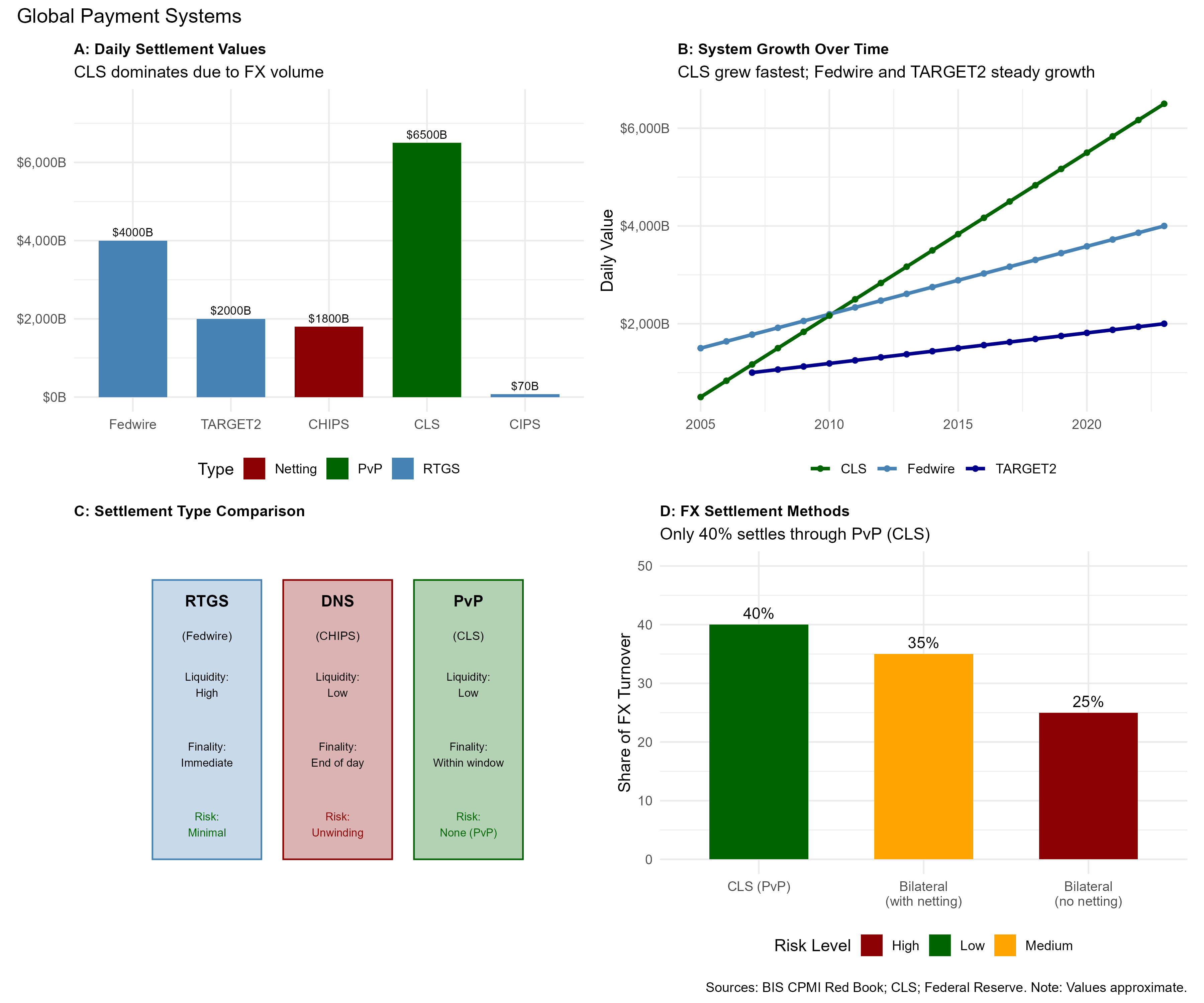
The **Clearing House Interbank Payments System (CHIPS)** is a private alternative to Fedwire, owned by a consortium of large banks. It processes roughly $1.8 trillion daily—less than Fedwire in gross terms, but serving different purposes:

* Cross-border dollar payments (correspondent banking)
* Foreign exchange settlement (one leg)
* Large commercial transactions

Unlike Fedwire's real-time gross settlement, CHIPS uses **netting**. Payments accumulate during the day, and bilateral positions are calculated continuously. Only net balances settle—in reserves via Fedwire—at designated times. This economizes dramatically on reserves: $1.8 trillion in gross payments might net to $50 billion in actual reserve movements.

| System  | Settlement Method    | Reserve Efficiency                   | Finality   |
| ------- | -------------------- | ------------------------------------ | ---------- |
| Fedwire | Real-time gross      | Low (need reserves for each payment) | Immediate  |
| CHIPS   | Multilateral netting | High (only net positions settle)     | End of day |

The tradeoff is **settlement risk**. In a gross settlement system, each payment is final when it settles—failure of one participant doesn't affect others. In a netting system, participants are interdependent: if one bank fails before the net settles, the netting must be unwound, potentially affecting all participants. CHIPS manages this through loss-sharing arrangements and prefunding requirements, but the tradeoff between liquidity efficiency and interdependence remains.

> **Table 5.1: Fedwire vs CHIPS—Detailed Comparison of Large-Value Dollar Payment Systems**
>
> The United States operates two parallel large-value payment systems, each optimizing for different objectives.
>
> ***
>
> #### **System Architecture**

| Feature               | Fedwire                                        | CHIPS                                           |
| --------------------- | ---------------------------------------------- | ----------------------------------------------- |
| **Operator**          | Federal Reserve Banks                          | The Clearing House (private consortium)         |
| **Ownership**         | Public (Federal Reserve System)                | Private (owned by 45+ member banks)             |
| **Settlement method** | Real-Time Gross Settlement (RTGS)              | Continuous multilateral netting with final RTGS |
| **Settlement medium** | Federal Reserve bank reserves                  | CHIPS balances → Fedwire for final settlement   |
| **Finality**          | Immediate and irrevocable                      | Final upon settlement (intraday completion)     |
| **Operating hours**   | 21.5 hours/day (9:00 PM - 6:30 PM ET next day) | 5:00 AM - 5:00 PM ET                            |

> ***
>
> #### **Volume and Value Statistics (2023-2024)**

| Metric                   | Fedwire                               | CHIPS                  |
| ------------------------ | ------------------------------------- | ---------------------- |
| **Daily value**          | \~$4.0 trillion                       | \~$1.8 trillion        |
| **Daily transactions**   | \~500,000-600,000                     | \~400,000-500,000      |
| **Average payment size** | \~$7-8 million                        | \~$4 million           |
| **Annual value**         | \~$1,000+ trillion                    | \~$450 trillion        |
| **Participants**         | \~10,000 (direct Fed account holders) | 45 direct participants |

> *Sources: Federal Reserve Payment System Reports (2024); The Clearing House Annual Reports.*
>
> ***
>
> #### **Settlement Mechanics—Step by Step**
>
> **Fedwire (Gross Settlement):**

| Step                   | Process                                     | Balance Sheet Impact             |
| ---------------------- | ------------------------------------------- | -------------------------------- |
| 1                      | Bank A initiates payment of $100M to Bank B | Bank A instructs Federal Reserve |
| 2                      | Fed debits Bank A's reserve account         | Bank A reserves: -$100M          |
| 3                      | Fed credits Bank B's reserve account        | Bank B reserves: +$100M          |
| 4                      | Settlement complete                         | Final and irrevocable            |
| **Time elapsed**       | Seconds                                     |                                  |
| **Liquidity required** | $100M (full amount)                         |                                  |

> **CHIPS (Netting Settlement):**

| Step                   | Process                              | Balance Sheet Impact                      |
| ---------------------- | ------------------------------------ | ----------------------------------------- |
| 1                      | Bank A sends $100M payment to Bank B | Enters CHIPS queue                        |
| 2                      | Bank B sends $80M payment to Bank A  | Enters CHIPS queue                        |
| 3                      | Bank A sends $50M to Bank C          | Enters CHIPS queue                        |
| 4                      | Bank C sends $40M to Bank A          | Enters CHIPS queue                        |
| 5                      | Continuous bilateral netting         | Net: A owes B $20M; A owes C $10M         |
| 6                      | Multilateral offset                  | Net positions calculated across all pairs |
| 7                      | Final settlement via Fedwire         | Only net amounts settle in reserves       |
| **Time elapsed**       | Throughout day, final by 5:00 PM     |                                           |
| **Liquidity required** | \~$30M (net) vs $290M (gross)        | 90%+ reduction                            |

> ***
>
> #### **Liquidity and Risk Management**

| Feature              | Fedwire                                                    | CHIPS                                         |
| -------------------- | ---------------------------------------------------------- | --------------------------------------------- |
| **Intraday credit**  | Fed provides daylight overdrafts (up to $200B+ daily peak) | Participants prefund \~$50B each morning      |
| **Credit source**    | Central bank (unlimited capacity)                          | Participant pool + loss-sharing               |
| **Collateral**       | Optional (reduces overdraft fees)                          | Prefunding held at Federal Reserve            |
| **Failure handling** | Each payment independent                                   | Unwinding rules; loss-sharing among survivors |
| **Systemic risk**    | Lower (gross settlement)                                   | Higher (netting interdependence)              |

> ***
>
> #### **Use Cases and Specialization**

| Purpose                                | Preferred System   | Rationale                                   |
| -------------------------------------- | ------------------ | ------------------------------------------- |
| Fed monetary policy operations         | Fedwire            | Direct Fed involvement                      |
| Securities settlement (Fed securities) | Fedwire Securities | Integration with Treasury/agency securities |
| Treasury securities purchases          | Fedwire            | Immediate finality required                 |
| Cross-border dollar payments           | CHIPS              | Correspondent banking efficiency            |
| FX transaction settlement (dollar leg) | CHIPS              | Netting across offsetting flows             |
| Large commercial payments              | Either             | Depends on timing/counterparty preferences  |
| Time-critical payments                 | Fedwire            | Immediate settlement                        |
| High-volume bilateral flows            | CHIPS              | Netting benefits maximize                   |

> ***
>
> #### **Key Observations**
>
> 1. **Complementary, not competing**: Fedwire and CHIPS serve different functions. Fedwire provides the ultimate settlement layer (central bank money); CHIPS economizes on that scarce resource through netting.
> 2. **CHIPS settles through Fedwire**: CHIPS is not independent—final settlement occurs via Fedwire transfers. CHIPS balances are ultimately claims on Fed reserves.
> 3. **Netting efficiency is enormous**: CHIPS processes $1.8T daily but requires only \~$50B in prefunding—a 97% reduction in liquidity needs. This efficiency enables the volume of cross-border dollar payments.
> 4. **Private vs public tradeoffs**: Fedwire has Fed's unlimited balance sheet behind it; CHIPS relies on private loss-sharing. In 2008, this distinction mattered—Fed extended Fedwire hours and liquidity while CHIPS participants faced bilateral credit concerns.
> 5. **International payments favor CHIPS**: Correspondent banks route cross-border dollar payments through CHIPS because netting reduces nostro account balances. A bank with offsetting flows (receiving from Asia, paying to Europe) can settle on net rather than gross.
> 6. **Operating hours reflect globalization**: Fedwire's extension to 21+ hours (2023) responds to global dollar demand. CHIPS's 5 AM open catches Asian-hour payments; its 5 PM close aligns with European close.
>
> ***
>
> #### **Money View Insights**
>
> * **Hierarchy within the dollar**: Fedwire settles in Fed reserves (highest-quality dollar); CHIPS settles in claims that become Fed reserves only at day's end. During the day, CHIPS participants extend credit to each other—CHIPS money is below Fed money in the hierarchy.
> * **The dealer function in payments**: CHIPS participants are dealers in payments—absorbing timing mismatches between inflows and outflows. Their willingness to accept "CHIPS money" (unsettled claims) for hours creates the liquidity that enables payment flows.
> * **Crisis reveals hierarchy**: In stress, demand shifts from CHIPS to Fedwire. Banks want immediate finality (Fed money) rather than netting promises. This is why the Fed extends Fedwire hours and liquidity in crises—to accommodate the flight from private to public settlement.
> * **Network effects in action**: CHIPS's value comes from having major banks as participants. A bank outside CHIPS must pay correspondent fees; inside CHIPS, it nets multilaterally. This creates a two-tier payment system within the dollar world.

> **CHIPS as Credit Engine:** From the money view, CHIPS is not just a netting mechanism—it's a **credit creation system**. During the day, when Bank A sends a CHIPS payment to Bank B, Bank B receives a claim (an entry in the CHIPS ledger) that won't settle in Fed reserves until later. For those intraday hours, Bank B must be willing to accept "CHIPS money"—promises backed by the CHIPS clearinghouse and its participants, not yet converted to Fed reserves. This willingness constitutes **intraday credit extension**. The system works because participants trust the clearing arrangement and the loss-sharing backstop. In stress, this trust can evaporate—participants demand immediate settlement (Fedwire) rather than accepting netting promises, causing liquidity to spike and the payments system to strain. CHIPS's efficiency depends on continuous mutual credit acceptance among major banks.

### ACH and Retail Payments

The **Automated Clearing House (ACH)** handles smaller, less time-sensitive payments:

* Payroll direct deposits
* Bill payments and subscriptions
* Government benefits (Social Security, tax refunds)
* Consumer transfers (Venmo and Zelle use ACH rails)

ACH processes roughly $80 trillion annually across 30 billion transactions—enormous volume but small average size (\~$2,600). Traditionally, ACH was batch-processed with 1-2 day settlement. Same-day ACH, introduced in 2016, shortened this for many payments.

**FedNow**, launched in 2023, brings real-time retail payments to the United States. Payments settle instantly, 24/7/365, in central bank money. This puts the US closer to parity with countries like the UK (Faster Payments, launched 2008), India (UPI), and Brazil (Pix) that already have instant retail payment systems.

### Domestic Infrastructure and International Flows

The structure of domestic payment systems shapes international flows:

1. **Access to Fedwire is access to dollars**. Foreign banks cannot hold accounts at the Fed directly (with limited exceptions). They access dollar settlement through US correspondent banks that do have Fed accounts.
2. **Operating hours create gaps**. Until recently, Fedwire closed when Asia opened. This created settlement risk for dollar payments initiated in Asian time zones.
3. **Netting reduces but doesn't eliminate risk**. CHIPS handles most cross-border dollar payments. Its netting efficiency depends on offsetting flows—when flows become one-directional (as in a crisis), netting benefits shrink and liquidity needs spike.
4. **The Fed is the ultimate backstop**. In 2008 and 2020, the Fed extended operating hours, provided unlimited intraday credit, and expanded eligible collateral. The payments system never froze because the Fed stood behind it.

## 5.2 SWIFT: The Messaging Layer

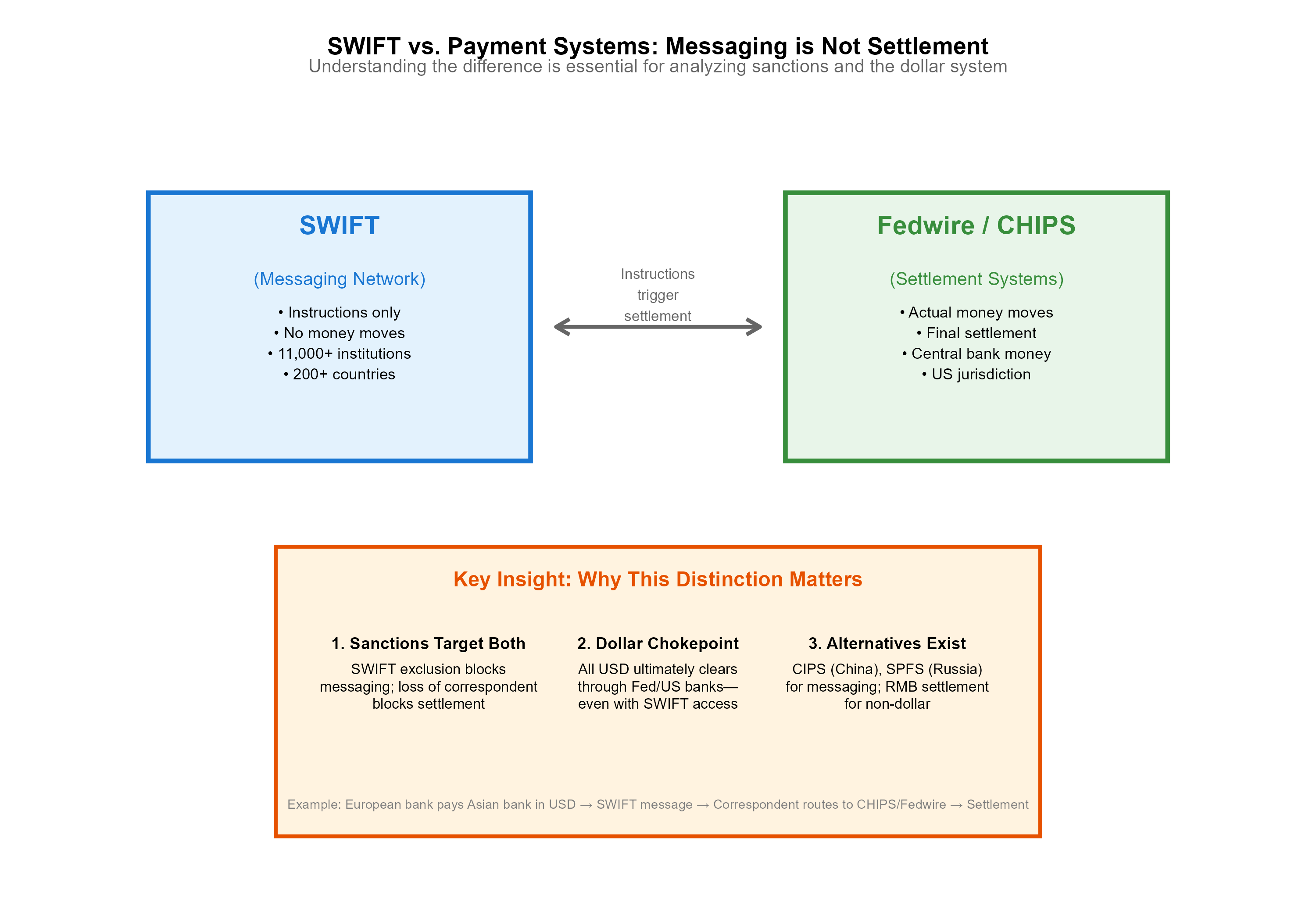
SWIFT is not a payment system. **SWIFT is a messaging network**—it tells banks what to do, but doesn't move money.

### What SWIFT Actually Does

SWIFT (Society for Worldwide Interbank Financial Telecommunication) is a cooperative owned by member banks, headquartered in Belgium. It provides:

1. **Standardized message formats** for payment instructions, securities transactions, trade finance, and treasury operations
2. **Secure transmission** of these messages between 11,000+ member institutions
3. **A common language** that allows banks worldwide to communicate unambiguously

When a bank in Singapore wants to pay $10 million to a bank in Brazil, the sequence is:

1. Singapore bank sends a SWIFT MT103 message (customer payment instruction)
2. Message travels through SWIFT's secure network
3. Singapore bank's US correspondent receives the instruction
4. Correspondent debits Singapore bank's nostro account
5. Correspondent initiates a Fedwire or CHIPS payment to Brazil bank's US correspondent
6. Brazil bank's correspondent credits Brazil bank's nostro account
7. Brazil bank credits the final recipient

SWIFT moved the information; Fedwire/CHIPS moved the money. The distinction matters for understanding sanctions.

### SWIFT Message Types

Different transactions require different message types:

| Category                        | Series | Purpose                        |
| ------------------------------- | ------ | ------------------------------ |
| Customer transfers              | MT1xx  | Payment instructions, checks   |
| Financial institution transfers | MT2xx  | Bank-to-bank payments          |
| Treasury markets                | MT3xx  | FX, money markets, derivatives |
| Collections and cash letters    | MT4xx  | Documentary credits            |
| Securities markets              | MT5xx  | Settlement instructions        |
| Precious metals                 | MT6xx  | Commodity transactions         |
| Documentary credits             | MT7xx  | Letters of credit              |
| Traveler's checks               | MT8xx  | (largely obsolete)             |
| Cash management                 | MT9xx  | Account statements, netting    |

The MT103 (customer credit transfer) and MT202 (bank-to-bank transfer) are workhorses of international payments. SWIFT is transitioning to ISO 20022, a more data-rich standard that enables better compliance screening and richer payment information.

### SWIFT Statistics

| Metric              | Value (2023)             |
| ------------------- | ------------------------ |
| Member institutions | \~11,500                 |
| Countries connected | 200+                     |
| Daily messages      | \~45 million             |
| Annual messages     | \~11 billion             |
| Peak capacity       | 42+ million messages/day |

SWIFT's dominance reflects network effects: because everyone uses SWIFT, everyone must use SWIFT. Alternative messaging systems exist (CIPS for China, SPFS for Russia), but none approach SWIFT's global reach.

### The SWIFT Sanctions Debate

When Russia invaded Ukraine in 2022, Western nations excluded major Russian banks from SWIFT. Headlines declared Russia "cut off from the global financial system"—overstating the impact while obscuring the actual chokepoint.

**What SWIFT exclusion does:**

* Prevents Russian banks from sending/receiving SWIFT messages
* Forces use of alternative communication (telex, email, phone, bilateral channels)
* Increases transaction costs and processing times
* Creates uncertainty about which transactions will clear

**What SWIFT exclusion does NOT do:**

* Block access to dollars (that requires US sanctions on correspondent relationships)
* Prevent all international payments (alternatives exist, though less efficient)
* Affect transactions within Russia's domestic payment system

The real financial chokepoint is **access to US correspondent banks and dollar clearing**. A Russian bank that found alternative messaging channels but remained under OFAC sanctions still could not clear dollars through the US financial system. Conversely, a bank with SWIFT access but no US correspondent relationship cannot settle dollar payments.

SWIFT exclusion is visible and symbolic; correspondent banking restrictions are technical but more powerful. The combination is devastating; either alone is manageable.

<figure><img src="https://3361520045-files.gitbook.io/~/files/v0/b/gitbook-x-prod.appspot.com/o/spaces%2FG4yYDrutm5bw16KnLiYZ%2Fuploads%2Fgit-blob-85ad4cdf816281382ebf3512c81d12dbc7b40a34%2Ffig05_5_swift_vs_payment_systems.png?alt=media" alt="Diagram distinguishing SWIFT messaging network from actual payment settlement systems, showing SWIFT instructions flowing to Fedwire, CHIPS, and other systems for final settlement"><figcaption><p><strong>Figure 5.2:</strong> SWIFT vs. Payment Systems: Messaging is Not Settlement. SWIFT provides messaging; settlement occurs in separate systems like Fedwire and CHIPS. <em>Illustrative.</em></p></figcaption></figure>

## 5.3 Correspondent Banking: The Traditional Model

Most cross-border payments flow through **correspondent banking** relationships—arrangements where banks hold accounts with each other to facilitate payments across jurisdictions.

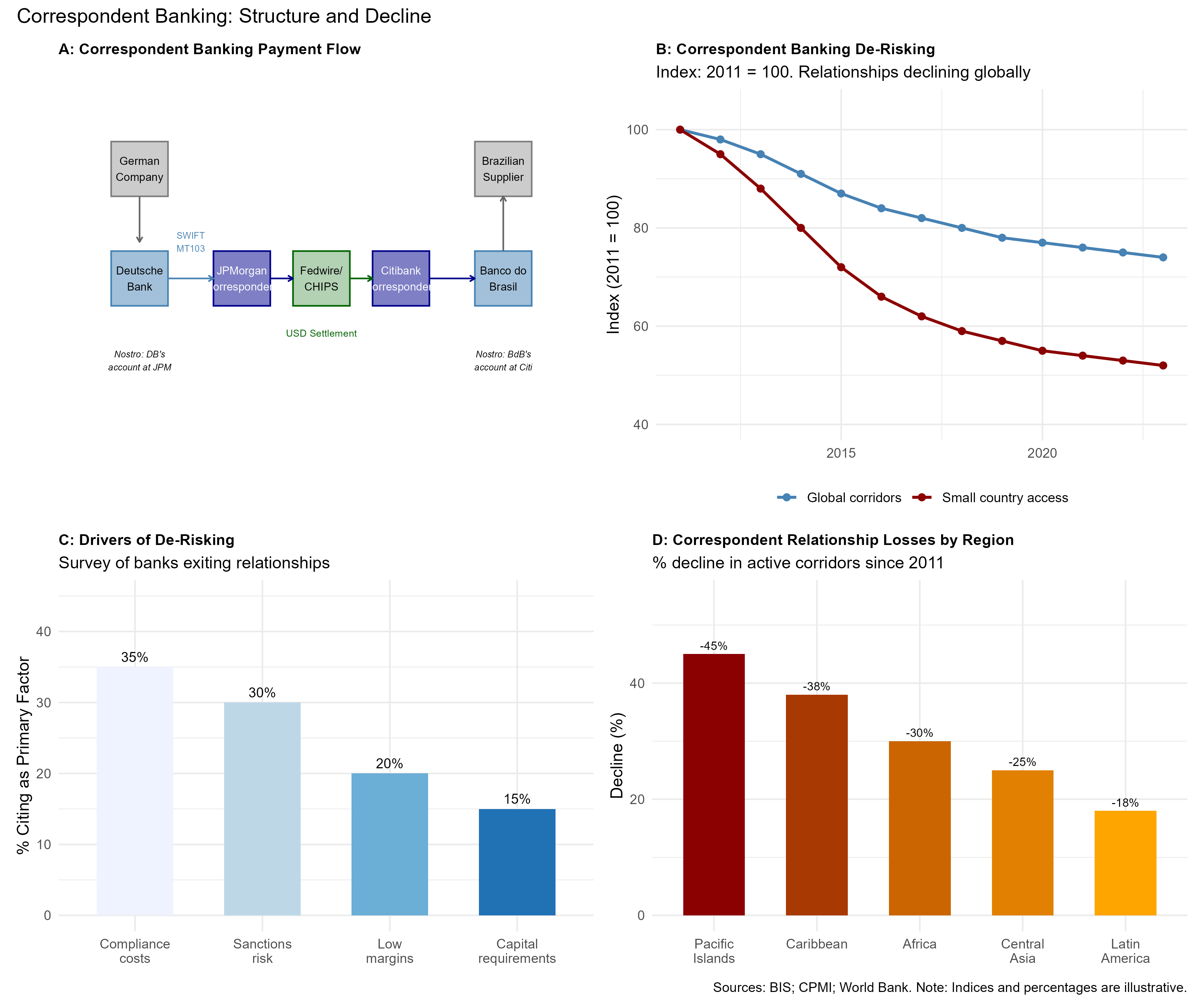
<figure><img src="https://3361520045-files.gitbook.io/~/files/v0/b/gitbook-x-prod.appspot.com/o/spaces%2FG4yYDrutm5bw16KnLiYZ%2Fuploads%2Fgit-blob-05f7579ff3348ed518634df19455d8110ee5dbfd%2Ffig05_2_correspondent_banking.png?alt=media" alt="Network diagram showing correspondent banking relationships with major US banks at center connected to regional banks worldwide through nostro/vostro account relationships"><figcaption><p><strong>Figure 5.3:</strong> Correspondent Banking Networks. International payments flow through chains of correspondent relationships, with US banks as key nodes for dollar transactions. <em>Illustrative.</em></p></figcaption></figure>

### The Nostro/Vostro Structure

A **nostro account** ("ours" in Italian) is an account a bank holds with a foreign bank. A **vostro account** ("yours") is the same account from the perspective of the bank holding it. If Deutsche Bank holds a dollar account at JPMorgan:

* Deutsche Bank calls it "our nostro account at JPMorgan"
* JPMorgan calls it "Deutsche Bank's vostro account with us"

Same account, different perspectives. The nostro/vostro terminology clarifies which side is being discussed.

> **The Cost of Nostro Accounts:** Nostro accounts represent **trapped liquidity**. Deutsche Bank must prefund its nostro account at JPMorgan with dollars—keeping a balance large enough to cover expected payment outflows. These dollars earn minimal or zero interest (depending on the correspondent agreement), yet they tie up bank capital. The opportunity cost is the return Deutsche Bank could earn by deploying those dollars elsewhere (lending, investing, trading). For a global bank network, nostro balances across dozens of correspondent banks can total billions in idle liquidity. This cost structure explains: (1) why banks charge fees for cross-border payments (recovering nostro funding costs), (2) why de-risking happens (low-volume relationships don't justify nostro balances), and (3) why innovations like real-time settlement or blockchain promise efficiency gains (by reducing prefunding needs). The inefficiency is not technical but structural—correspondent banking requires immobilizing liquidity across a fragmented network.

### How Correspondent Banking Works

Consider a payment from a German company to a Brazilian supplier:

**Step 1: Instruction** German company instructs Deutsche Bank to pay $1 million to Banco do Brasil account

**Step 2: Debit originator** Deutsche Bank debits German company's euro account (converting at spot rate)

**Step 3: SWIFT message** Deutsche Bank sends MT103 to its US correspondent (say, JPMorgan) instructing dollar payment

**Step 4: Dollar leg** JPMorgan debits Deutsche Bank's nostro account, sends CHIPS payment to Citibank (Banco do Brasil's correspondent)

**Step 5: Credit correspondent** Citibank credits Banco do Brasil's nostro account

**Step 6: Credit beneficiary** Banco do Brasil credits Brazilian supplier's account

This payment involved:

* Two currency conversions (EUR→USD, USD→BRL at destination)
* Four banks (Deutsche Bank, JPMorgan, Citibank, Banco do Brasil)
* Multiple ledger entries
* Message flows across SWIFT
* Settlement through US payment systems

Each intermediary charges fees and takes time. This explains why international payments are expensive ($25-50+ in fees) and slow (1-5 business days) compared to domestic transfers.

> **Table 5.2: Cross-Border Payment Flow—Complete Chain from Originator to Beneficiary**
>
> A German importer pays $1 million to a Brazilian exporter for coffee. The table traces the complete payment chain: every institution, message, ledger entry, and time delay.
>
> ***
>
> #### **Transaction Details**

| Parameter            | Value                               |
| -------------------- | ----------------------------------- |
| Originator           | German Coffee GmbH (Munich)         |
| Beneficiary          | Café Brasil Exportadora (São Paulo) |
| Amount               | $1,000,000 USD                      |
| Purpose              | Payment for coffee shipment         |
| Originating currency | EUR (converted to USD)              |
| Final currency       | BRL (converted from USD)            |

> ***
>
> #### **Complete Payment Chain**

| Step   | Time               | Institution            | Action                                       | Ledger Entry                  | Currency |
| ------ | ------------------ | ---------------------- | -------------------------------------------- | ----------------------------- | -------- |
| **1**  | T+0 (9:00 AM CET)  | German Coffee GmbH     | Initiates payment via online banking         | Instructions to Deutsche Bank | —        |
| **2**  | T+0 (9:15 AM)      | Deutsche Bank (Munich) | Debits German Coffee's euro account          | GmbH account: -€920,000       | EUR      |
|        |                    |                        | Executes FX conversion EUR→USD               | Internal FX desk              |          |
|        |                    |                        | Sends SWIFT MT103 to correspondent           | Message to JPMorgan NY        |          |
| **3**  | T+0 (9:30 AM)      | SWIFT Network          | Routes message: Munich → Brussels → New York | Secure transmission           | —        |
| **4**  | T+0 (4:00 AM ET)   | JPMorgan (New York)    | Receives MT103, queues for CHIPS processing  | Pending queue                 | —        |
|        |                    |                        | Compliance screening (OFAC, AML)             | Automated + manual review     |          |
| **5**  | T+0 (9:00 AM ET)   | JPMorgan               | Debits Deutsche Bank's nostro account        | DB nostro: -$1,000,000        | USD      |
|        |                    |                        | Sends CHIPS payment to Citibank              | CHIPS instruction             |          |
| **6**  | T+0 (9:05 AM ET)   | CHIPS                  | Queues payment for netting                   | Enters multilateral net       | USD      |
| **7**  | T+0 (5:00 PM ET)   | CHIPS                  | Net settlement via Fedwire                   | JPM→Citi net position settles | USD      |
| **8**  | T+0 (5:01 PM ET)   | Citibank (New York)    | Credits Banco do Brasil's nostro account     | BdB nostro: +$1,000,000       | USD      |
|        |                    |                        | Sends SWIFT MT103 to São Paulo               | Message to BdB Brazil         |          |
| **9**  | T+1 (8:00 AM BRT)  | Banco do Brasil (SP)   | Receives MT103, compliance review            | Internal processing           | —        |
|        |                    |                        | Executes FX conversion USD→BRL               | Internal FX desk              |          |
|        |                    |                        | Credits Café Brasil's BRL account            | Café Brasil: +R$5,000,000     | BRL      |
| **10** | T+1 (10:00 AM BRT) | Café Brasil            | Receives notification of payment             | Payment complete              | BRL      |

> ***
>
> #### **Fee Structure (Illustrative)**

| Fee Component              | Amount       | Charged By      | Notes                         |
| -------------------------- | ------------ | --------------- | ----------------------------- |
| Originating bank FX spread | \~$3,000     | Deutsche Bank   | 0.30% on EUR→USD              |
| Wire transfer fee          | $35          | Deutsche Bank   | Flat outgoing wire fee        |
| SWIFT messaging            | $5           | Deutsche Bank   | Pass-through                  |
| Correspondent fee          | $25          | JPMorgan        | Nostro maintenance/processing |
| CHIPS settlement           | $2           | CHIPS           | Per-transaction fee           |
| Receiving correspondent    | $20          | Citibank        | Processing fee                |
| Beneficiary bank FX spread | \~$5,000     | Banco do Brasil | 0.50% on USD→BRL (EM spread)  |
| Incoming wire fee          | $15          | Banco do Brasil | Credited to beneficiary net   |
| **Total fees**             | **\~$8,102** |                 | **0.81% of payment**          |

> ***
>
> #### **Time Analysis**

| Segment                       | Duration             | Cause of Delay                       |
| ----------------------------- | -------------------- | ------------------------------------ |
| Originator → Originating bank | 15 minutes           | Customer authentication, input       |
| Originating bank processing   | 45 minutes           | Compliance, FX execution             |
| SWIFT transmission            | Seconds              | Electronic messaging                 |
| Correspondent bank processing | 4-5 hours            | Time zone (Munich→NY), CHIPS queuing |
| CHIPS netting cycle           | 8 hours              | Batch settlement at day end          |
| Final settlement (Fedwire)    | 1 minute             | Real-time gross settlement           |
| Receiving correspondent       | Overnight            | Time zone (NY→São Paulo)             |
| Beneficiary bank processing   | 2 hours              | Compliance, FX, crediting            |
| **Total elapsed time**        | **\~25 hours (T+1)** |                                      |

> ***
>
> #### **Balance Sheet Impacts**
>
> **Deutsche Bank (Originating Bank)**

| Assets                 | Change      | Liabilities              | Change      |
| ---------------------- | ----------- | ------------------------ | ----------- |
| Nostro at JPMorgan     | -$1,000,000 | Customer deposit (GmbH)  | -€920,000   |
| FX position (EUR sold) | +€920,000   | FX position (USD bought) | +$1,000,000 |

> **JPMorgan (US Correspondent)**

| Assets                          | Change            | Liabilities          | Change      |
| ------------------------------- | ----------------- | -------------------- | ----------- |
| CHIPS balance (during day)      | -$1,000,000 (net) | Deutsche Bank vostro | -$1,000,000 |
| Fed reserves (after settlement) | -(net amount)     |                      |             |

> **Citibank (US Correspondent)**

| Assets                          | Change            | Liabilities            | Change      |
| ------------------------------- | ----------------- | ---------------------- | ----------- |
| CHIPS balance (during day)      | +$1,000,000 (net) | Banco do Brasil vostro | +$1,000,000 |
| Fed reserves (after settlement) | +(net amount)     |                        |             |

> **Banco do Brasil (Beneficiary Bank)**

| Assets                   | Change      | Liabilities             | Change       |
| ------------------------ | ----------- | ----------------------- | ------------ |
| Nostro at Citibank       | +$1,000,000 | Customer deposit (Café) | +R$5,000,000 |
| FX position (USD bought) | +$1,000,000 | FX position (BRL sold)  | +R$5,000,000 |

> ***
>
> #### **Key Observations**
>
> 1. **Four banks, two currencies, one payment**: A single cross-border payment requires coordination among four banks across three countries, two currency conversions, and two FX spreads. Each intermediary adds fees and time.
> 2. **Dollar as vehicle currency**: Germany→Brazil goes through USD (EUR→USD→BRL) rather than direct EUR→BRL. Direct markets are too thin; the dollar route is actually more liquid and often cheaper.
> 3. **Nostro balances are trapped liquidity**: Deutsche Bank must prefund its JPMorgan nostro; Banco do Brasil must maintain its Citibank nostro. These balances earn little interest but enable payments. The aggregate nostro network ties up hundreds of billions in idle liquidity.
> 4. **Time zones drive delays**: Most delay is not processing but waiting—for markets to open, for CHIPS settlement, for next business day in another time zone.
> 5. **Fees fall disproportionately on EM leg**: The BRL conversion (0.5% spread) is more expensive than EUR conversion (0.3%) due to lower liquidity and higher volatility in emerging market currencies.
> 6. **Compliance is a major cost**: Each bank screens for sanctions (OFAC), anti-money laundering (AML), and know-your-customer (KYC). A flagged payment can add days while compliance reviews.
>
> ***
>
> #### **Money View Insights**
>
> * **Hierarchy of money spans borders**: The payment moves through hierarchy: commercial bank money (Deutsche Bank) → correspondent claim (JPMorgan nostro) → CHIPS balance → Fed reserves → correspondent claim (Citibank) → commercial bank money (Banco do Brasil). Each step involves a different layer of the hierarchy.
> * **Dollar settlement is the chokepoint**: Even though neither originator nor beneficiary wants dollars, the payment must clear through US dollar infrastructure. This gives the US leverage over international commerce—a theme we return to when discussing sanctions.
> * **Correspondent banks are dealers in payments**: JPMorgan and Citibank absorb timing mismatches, provide intraday credit, and manage the nostro/vostro relationship. They earn fees for this dealer function.
> * **The payment is a chain of IOUs**: Until final settlement in Fed reserves, each step creates a new IOU. Deutsche Bank's payment instruction is an IOU to JPMorgan; the CHIPS entry is a claim on CHIPS; only Fedwire settlement is final. The chain's integrity depends on trust at each link.

### The Dollar's Central Role

Most correspondent banking flows through dollars, even for payments between non-dollar countries. A payment from Thailand to Chile typically converts THB→USD→CLP rather than directly THB→CLP. Why?

1. **Liquidity**: USD/THB and USD/CLP markets are deep; THB/CLP is not
2. **Correspondent relationships**: Thai and Chilean banks have dollar correspondents; direct relationships are rare
3. **Payment infrastructure**: Dollar clearing systems are reliable and extended-hours
4. **Network effects**: Because everyone uses dollars, everyone must use dollars

The result is a hub-and-spoke structure with the dollar at the center. An estimated 88% of FX transactions involve the dollar on one side—far more than US trade would suggest. The dollar's role in payment infrastructure reinforces its currency dominance.

### De-risking and Financial Exclusion

Since 2010, global correspondent banking relationships have declined significantly. Major banks have "de-risked" by exiting relationships with:

* Banks in high-risk jurisdictions (small countries, conflict zones)
* Money transfer operators serving diaspora remittances
* Correspondent relationships with thin profit margins

Drivers of de-risking include:

| Factor                   | Impact                                                 |
| ------------------------ | ------------------------------------------------------ |
| AML/KYC compliance costs | $500K-2M+ annual cost per correspondent relationship   |
| Sanctions enforcement    | Billion-dollar fines for violations                    |
| Risk-based capital       | Correspondent balances require capital allocation      |
| Low margins              | Cannot justify compliance costs for small flow volumes |

The result is **financial exclusion**. Countries losing correspondent access face higher remittance costs, reduced trade finance availability, and difficulty participating in global commerce. The Pacific Islands, Caribbean, and parts of Africa have been particularly affected. De-risking intended to prevent illicit finance may push transactions into less transparent channels, worsening the problem it aimed to solve.

## 5.4 CLS: Solving FX Settlement Risk

Foreign exchange settlement has historically been one of the most dangerous activities in finance. The failure of a single mid-sized German bank in 1974 created risks that took decades to address, ultimately leading to CLS.

### The Herstatt Problem

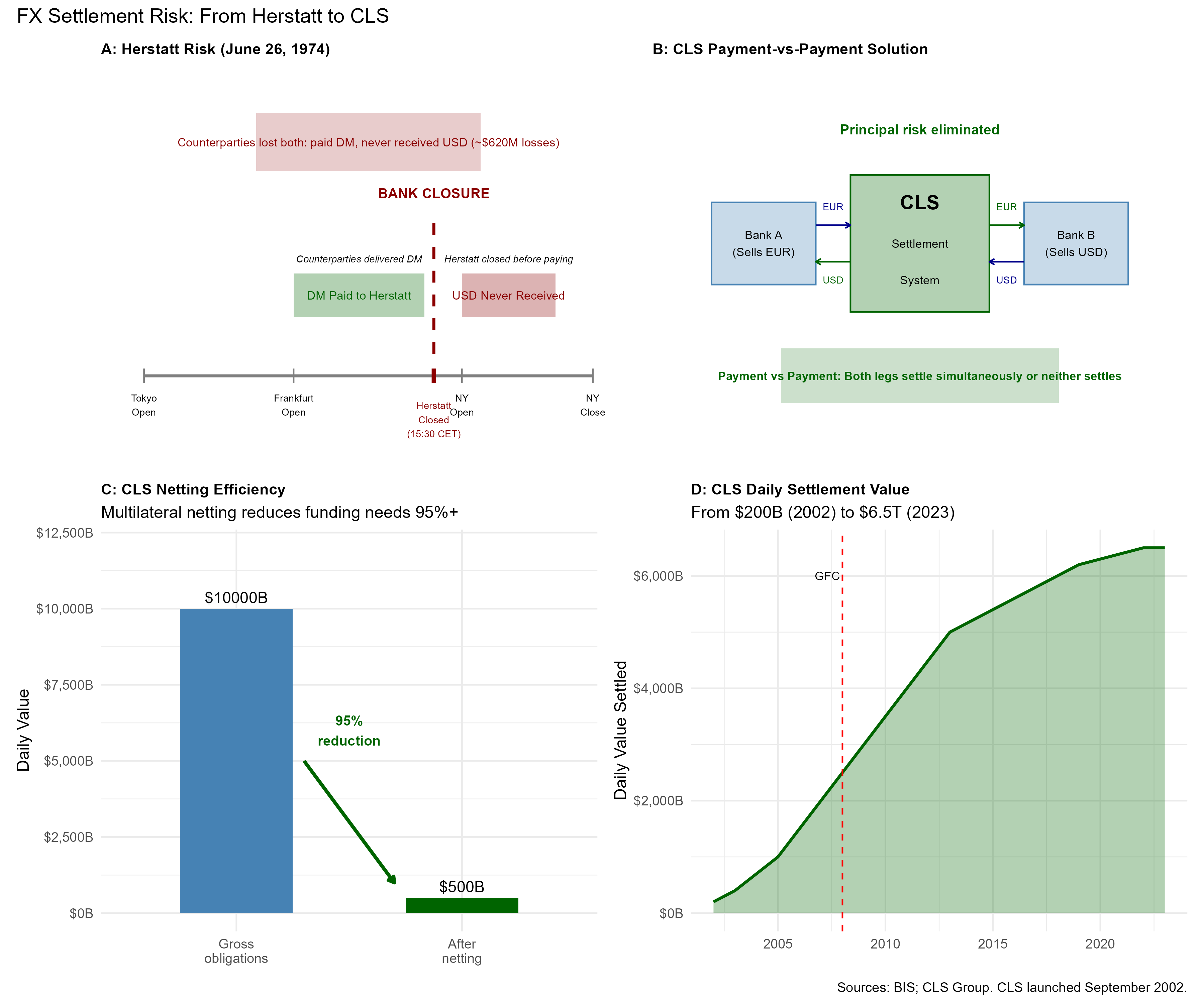
On June 26, 1974, **Bankhaus Herstatt**, a small German bank active in FX markets, was closed by regulators at 3:30 PM Frankfurt time. This was after the close of the German payment system but before the US system closed.

Banks that had sold Deutsche Marks to Herstatt had already delivered their DM (during German business hours). But Herstatt's closure prevented it from delivering the dollars it owed (during US business hours). Counterparties lost both: they had paid DM and received no USD.

Total losses: \~$620 million (1974 dollars, roughly $4 billion today)

Banks worldwide stopped making FX payments, uncertain which counterparties might fail. The FX market nearly seized.

**Herstatt risk** became the term for settlement risk arising from time zone differences in FX transactions. The problem has three components:

1. **Principal risk**: Losing the full amount paid (as Herstatt counterparties did)
2. **Replacement cost risk**: Cost of replacing a failed transaction at new market prices
3. **Liquidity risk**: Not receiving expected funds, creating cascading failures

### Why FX Settlement Is Dangerous

A spot FX transaction involves two currency legs settling in different payment systems:

| Leg   | Currency | Settlement System | Time Zone |
| ----- | -------- | ----------------- | --------- |
| Leg 1 | JPY      | BOJ-NET           | Tokyo     |
| Leg 2 | USD      | Fedwire/CHIPS     | New York  |

Tokyo closes before New York opens. If a bank delivers yen and its counterparty fails before delivering dollars, the delivering bank loses everything.

Before CLS, daily FX settlement exposure for large banks reached their entire capital base—sometimes multiples of it. A single counterparty failure during settlement could render multiple banks insolvent.

<figure><img src="https://3361520045-files.gitbook.io/~/files/v0/b/gitbook-x-prod.appspot.com/o/spaces%2FG4yYDrutm5bw16KnLiYZ%2Fuploads%2Fgit-blob-1177c64fce059abdd88eb8ec5bf09eeca6b7b591%2Ffig05_3_cls_herstatt.png?alt=media" alt="Diagram showing Herstatt risk in FX settlement before CLS, and how CLS payment-versus-payment mechanism eliminates settlement risk through simultaneous exchange of both currency legs"><figcaption><p><strong>Figure 5.4:</strong> CLS and the Herstatt Problem. CLS eliminates FX settlement risk through payment-versus-payment, addressing the vulnerability revealed by Herstatt's failure in 1974. <em>Illustrative.</em></p></figcaption></figure>

### The BIS Response and CLS Creation

The Bank for International Settlements studied Herstatt risk for two decades. In 2002, **CLS (Continuous Linked Settlement)** launched, backed by major central banks and owned by participating banks.

CLS's innovation is **payment-versus-payment (PvP)**: both legs of an FX transaction settle simultaneously, or neither settles. You cannot deliver yen without receiving dollars; you cannot receive dollars without delivering yen.

### How CLS Works

CLS operates accounts at 18 central banks and settles transactions in 18 currencies:

| Currency       | Central Bank              |
| -------------- | ------------------------- |
| USD            | Federal Reserve           |
| EUR            | ECB                       |
| GBP            | Bank of England           |
| JPY            | Bank of Japan             |
| CHF            | Swiss National Bank       |
| CAD            | Bank of Canada            |
| AUD            | Reserve Bank of Australia |
| And 11 more... | Various                   |

Settlement process:

1. **Trade matching**: Both counterparties submit trade details to CLS
2. **Funding**: Banks transfer currencies owed to their CLS accounts (during a 5-hour window when all relevant RTGS systems overlap)
3. **Settlement**: CLS simultaneously debits/credits both sides
4. **Pay-out**: Banks receive currencies owed from CLS

CLS also uses **multilateral netting**. Rather than settling each trade gross, CLS nets all of a bank's positions in each currency across all counterparties. A bank might have 10,000 trades but only a handful of net funding requirements.

| Metric                  | Without CLS  | With CLS       |
| ----------------------- | ------------ | -------------- |
| Daily gross obligations | $10 trillion | $10 trillion   |
| Funding needed          | $10 trillion | \~$500 billion |
| Netting efficiency      | 0%           | 95%+           |

> **Table 5.3: CLS Settlement Mechanism—Payment-versus-Payment in Action**
>
> A Japanese bank sells ¥15 billion to a UK bank for £100 million. The table shows how CLS eliminates Herstatt risk through simultaneous, irrevocable settlement of both legs.
>
> ***
>
> #### **Transaction Details**

| Parameter      | Value                          |
| -------------- | ------------------------------ |
| **Party A**    | Mizuho Bank (Tokyo)            |
| **Party B**    | Barclays (London)              |
| **Trade**      | Mizuho sells JPY, buys GBP     |
| **Amounts**    | ¥15,000,000,000 ↔ £100,000,000 |
| **Rate**       | 150 JPY/GBP                    |
| **Value date** | T+2 (standard spot)            |

> ***
>
> #### **Without CLS: Sequential Settlement (Herstatt Risk)**

| Time (UTC) | Tokyo Action                          | London Action                          | Risk Status                       |
| ---------- | ------------------------------------- | -------------------------------------- | --------------------------------- |
| 00:00      | BOJ-NET opens                         | —                                      | —                                 |
| 01:00      | Mizuho pays ¥15B to Barclays's nostro | —                                      | **RISK: Mizuho exposed for ¥15B** |
| 06:00      | BOJ-NET closes                        | —                                      | Mizuho fully exposed              |
| 07:00      | —                                     | CHAPS opens                            | —                                 |
| 08:00      | —                                     | Barclays pays £100M to Mizuho's nostro | Risk eliminated                   |

> **Herstatt scenario:** If Barclays fails at 06:30 (after Tokyo closes, before London opens), Mizuho has paid ¥15B and receives nothing. Principal loss = ¥15B (\~$100M).
>
> ***
>
> #### **With CLS: Payment-versus-Payment Settlement**
>
> **Pre-Settlement (T+1, Day Before Value Date)**

| Step | Time           | Action                                             | CLS Balance         |
| ---- | -------------- | -------------------------------------------------- | ------------------- |
| 1    | T+1, 14:00 UTC | Both banks submit matched trade to CLS             | Trade matched       |
| 2    | T+1, 18:00 UTC | CLS calculates each bank's net pay-in per currency | Pay-in schedule set |

> **Settlement Day (T+2, Value Date)**

| Step  | Time (UTC)  | Mizuho                                            | Barclays                                           | CLS                                    | Status                      |
| ----- | ----------- | ------------------------------------------------- | -------------------------------------------------- | -------------------------------------- | --------------------------- |
| **3** | 00:00       | —                                                 | —                                                  | Opens settlement window                | 18 RTGS systems operational |
| **4** | 06:00-07:00 | Mizuho pays ¥15B to its CLS account (via BOJ-NET) | Barclays pays £100M to its CLS account (via CHAPS) | CLS receives both currencies           | Both legs funded            |
| **5** | 07:00       | —                                                 | —                                                  | CLS verifies both accounts are funded  | Verification complete       |
| **6** | 07:00:01    | CLS credits Mizuho's CLS account: +£100M          | CLS credits Barclays's CLS account: +¥15B          | **Simultaneous, irrevocable transfer** | **PvP complete**            |
| **7** | 07:00:02    | Mizuho requests GBP pay-out                       | Barclays requests JPY pay-out                      | CLS pays out via RTGS                  | —                           |
| **8** | 08:00       | Receives £100M at nostro in London                | Receives ¥15B at nostro in Tokyo                   | Pay-outs complete                      | Settlement finalized        |

> ***
>
> #### **CLS Balance Sheet Mechanics**
>
> **CLS Bank Balance Sheet (at settlement moment, 07:00:01)**

| Assets                 |                 | Liabilities           |                 |
| ---------------------- | --------------- | --------------------- | --------------- |
| JPY at Bank of Japan   | ¥15,000,000,000 | Due to Mizuho (GBP)   | £100,000,000    |
| GBP at Bank of England | £100,000,000    | Due to Barclays (JPY) | ¥15,000,000,000 |
| **Total**              | ¥15B + £100M    | **Total**             | £100M + ¥15B    |

> CLS holds accounts at 18 central banks. It receives currencies in and pays currencies out. At any moment, its assets (central bank deposits) exactly match its liabilities (amounts owed to members). CLS takes no market risk, no credit risk, no FX risk—it is pure settlement infrastructure.
>
> ***
>
> #### **The Critical 5-Hour Window**
>
> CLS settlement depends on a 5-hour window when all 18 relevant RTGS systems are simultaneously open:

| Time (UTC)      | Americas         | Europe                    | Asia-Pacific                    |
| --------------- | ---------------- | ------------------------- | ------------------------------- |
| 00:00           | Closed           | Closed                    | Open (Tokyo, Sydney, Singapore) |
| 06:00           | —                | Opens (London, Frankfurt) | Closing (Tokyo)                 |
| **06:00-11:00** | —                | **OVERLAP WINDOW**        | **OVERLAP WINDOW**              |
| 07:00           | Opens (New York) | Open                      | Closing                         |
| 12:00           | Open             | Closing                   | Closed                          |

> The 06:00-11:00 UTC window is when CLS can simultaneously fund and settle all 18 currencies. Outside this window, not all legs can achieve same-day finality.
>
> ***
>
> #### **Multilateral Netting Efficiency**
>
> CLS doesn't just settle trades one-by-one. It nets each member's position across all trades:

| Bank                   | JPY Bought | JPY Sold | Net JPY          | GBP Bought | GBP Sold | Net GBP          |
| ---------------------- | ---------- | -------- | ---------------- | ---------- | -------- | ---------------- |
| Mizuho                 | ¥0         | ¥50B     | -¥50B            | £300M      | £0       | +£300M           |
| Barclays               | ¥30B       | ¥0       | +¥30B            | £0         | £200M    | -£200M           |
| Deutsche               | ¥20B       | ¥10B     | +¥10B            | £50M       | £150M    | -£100M           |
| JPMorgan               | ¥15B       | ¥5B      | +¥10B            | £0         | £0       | £0               |
| **Gross**              | ¥65B       | ¥65B     |                  | £350M      | £350M    |                  |
| **Net funding needed** |            |          | ¥50B             |            |          | £200M            |
| **Netting efficiency** |            |          | **23% of gross** |            |          | **57% of gross** |

> ***
>
> #### **Risk Reduction Statistics**

| Metric                       | Pre-CLS (Bilateral) | With CLS       | Improvement      |
| ---------------------------- | ------------------- | -------------- | ---------------- |
| **Daily principal at risk**  | $5-6 trillion       | $0             | 100% elimination |
| **Funding needed**           | $5-6 trillion       | \~$300 billion | 95%+ reduction   |
| **Settlement exposures**     | Multiple days       | Intraday only  | —                |
| **Counterparty credit risk** | High (bilateral)    | Zero (PvP)     | Eliminated       |

> ***
>
> #### **Key Observations**
>
> 1. **PvP is the innovation**: The genius of CLS is simple—don't let one leg settle without the other. This eliminates the fundamental asymmetry that created Herstatt risk.
> 2. **Central bank accounts are essential**: CLS works because it holds accounts at 18 central banks. Each currency leg settles in central bank money, not commercial bank money. This puts CLS at the apex of the money hierarchy for FX settlement.
> 3. **Time zone coordination is the constraint**: The 5-hour window limits which trades can settle same-day. Trades involving, say, NZD and MXN face narrow overlap. CLS's expansion to new currencies depends on RTGS operating hours.
> 4. **Netting massively reduces funding needs**: The 95%+ netting efficiency means CLS members fund only net positions. A bank with $50B in buys and $49B in sells funds only $1B.
> 5. **Not all FX settles through CLS**: Only \~40% of global FX uses CLS. The rest settles bilaterally—either because currencies aren't CLS-eligible, counterparties aren't members, or the trade structure doesn't fit.
> 6. **Membership is expensive**: CLS membership requires significant investment (systems, liquidity management, operational capacity). Smaller banks access CLS through larger member banks ("third-party services"), adding an intermediation layer.
>
> ***
>
> #### **Money View Insights**
>
> * **CLS embodies the hierarchy**: CLS settles in central bank money (top of hierarchy) because that's the only money trustworthy enough for irrevocable FX settlement. Commercial bank money won't do—the whole point is eliminating bank failure risk.
> * **The dealer's survival constraint, managed collectively**: Pre-CLS, each FX dealer bore bilateral Herstatt risk. CLS mutualizes settlement risk—if one member fails mid-settlement, CLS's loss-sharing rules distribute the impact. The system's survival constraint binds collectively, not individually.
> * **Infrastructure creates hierarchy**: CLS membership creates a two-tier FX market. Members settle efficiently with zero principal risk. Non-members face higher costs and residual settlement risk. Access to CLS is access to the safest tier of FX settlement.
> * **The 1974 failure still echoes**: CLS exists because of Bankhaus Herstatt. Fifty years later, global infrastructure reflects that single failure. This is how crises reshape the financial system—not through policy papers but through the hard lessons of failure.

### CLS Statistics

| Metric                     | Value (2023)    |
| -------------------------- | --------------- |
| Daily value settled        | \~$6.5 trillion |
| Average daily instructions | \~1.4 million   |
| Settlement members         | 70+             |
| Peak single day            | $15+ trillion   |
| Currencies covered         | 18              |

CLS settles roughly 40% of global FX transactions by value. The remainder settles bilaterally—because the currencies aren't CLS-eligible, the counterparties aren't members, or the trade structure doesn't fit CLS parameters.

### Remaining FX Settlement Risk

Despite CLS's success, substantial FX settlement risk remains. A 2019 BIS survey found:

* Only 40% of FX trades settle through PvP mechanisms
* $8.9 trillion daily settles with some principal risk
* Risk has grown as FX volumes increased

Why don't all trades use CLS?

1. **Currency coverage**: CLS covers 18 currencies; the world has 180+
2. **Membership**: Only 70+ banks are direct members; others use correspondents
3. **Product scope**: Some FX products (options, NDFs) don't fit CLS
4. **Cost**: CLS fees may exceed bilateral settlement for small trades
5. **Time zones**: Some trades occur outside CLS's settlement window

Regulators continue pushing for expanded PvP coverage, but progress is slow.

## 5.5 Regional Payment Systems

Regional systems serve particular geographies and currencies.

### TARGET2: Eurozone Settlement

**TARGET2** (Trans-European Automated Real-time Gross Settlement Express Transfer System) is the Eurozone's RTGS system, operated by the Eurosystem (ECB plus national central banks).

| Feature            | Specification           |
| ------------------ | ----------------------- |
| Daily value        | \~€2 trillion           |
| Daily transactions | \~400,000               |
| Operating hours    | 07:00-18:00 CET         |
| Settlement         | Real-time, gross, final |

TARGET2 enables:

* Settlement of euro payments between Eurozone banks
* Monetary policy operations (refinancing, standing facilities)
* Settlement of euro legs of CLS transactions
* Connection to securities settlement (TARGET2-Securities)

**TARGET2 balances** became controversial during the Eurozone crisis. When capital fled peripheral countries (Greece, Italy, Spain) for core countries (Germany), TARGET2 recorded the flows as claims and liabilities between national central banks. By 2012, the Bundesbank's TARGET2 claims exceeded €700 billion—money "owed" by peripheral central banks.

Interpretations diverged sharply:

| View      | Interpretation                                                        |
| --------- | --------------------------------------------------------------------- |
| Alarmist  | Germany has lent €700B to insolvent periphery                         |
| Technical | TARGET2 simply records payment flows; balances are accounting entries |
| Systemic  | Balances reflect capital flight; would crystallize if euro broke up   |

In a functioning currency union, TARGET2 balances are no more meaningful than flows between Federal Reserve districts. But the Eurozone's uncertain political architecture made them politically explosive.

### CIPS: China's Cross-Border System

The **Cross-Border Interbank Payment System (CIPS)** launched in 2015 to support RMB internationalization. It provides:

* RTGS for cross-border yuan payments
* Clearing and settlement for offshore RMB
* An alternative to dollar-based correspondent banking for RMB flows

| Metric             | Value (2023)                 |
| ------------------ | ---------------------------- |
| Daily transactions | \~26,000                     |
| Daily value        | ~~¥500 billion (~~$70B)      |
| Participants       | 1,400+ (direct and indirect) |
| Countries covered  | 110+                         |

CIPS remains far smaller than dollar systems:

| System  | Daily Value   | Currency |
| ------- | ------------- | -------- |
| Fedwire | $4 trillion   | USD      |
| TARGET2 | €2 trillion   | EUR      |
| CHIPS   | $1.8 trillion | USD      |
| CIPS    | $70 billion   | CNY      |

CIPS matters less for current volumes than for future potential. As RMB usage expands, CIPS provides infrastructure independent of US-controlled systems—an alternative for countries seeking to reduce dollar dependence, though one with its own political implications.

### Other Regional Systems

**SPFS** (System for Transfer of Financial Messages): Russia's SWIFT alternative, developed after 2014 Crimea sanctions. Connects \~400 Russian banks plus some foreign participants. Limited international reach.

**UPI** (Unified Payments Interface): India's instant payment system, processing billions of transactions monthly. Primarily domestic but being offered to other countries as a model.

**SEPA** (Single Euro Payments Area): Eurozone retail payments integration, enabling cross-border euro transfers at domestic prices.

**TIPS** (TARGET Instant Payment Settlement): Eurozone instant payments, settling in central bank money 24/7/365.

## 5.6 Settlement Risk and Systemic Implications

Payment system failure—or even uncertainty about reliability—can trigger cascading problems across the financial system.

### Types of Settlement Risk

**Credit risk**: A counterparty fails to deliver what it owes. In gross settlement, each payment is independent; in netting, one failure can unwind the net.

**Liquidity risk**: Expected funds don't arrive on time, even if the counterparty is solvent. A bank planning to use incoming funds to meet outgoing obligations may face a gap.

**Operational risk**: System failures, cyberattacks, or processing errors prevent settlement.

**Legal risk**: Uncertainty about whether a payment is legally final, especially across jurisdictions.

### Central Bank Liquidity and the Payments System

Central banks provide liquidity to ensure payment systems function:

**Intraday credit**: The Fed extends daylight overdrafts to banks needing reserves before incoming payments arrive. This prevents payment gridlock but creates credit exposure for the Fed.

**Standing facilities**: Banks can borrow overnight from central banks (discount window, marginal lending facility) if they end the day short of reserves.

**Emergency liquidity**: In crises, central banks extend operating hours, accept broader collateral, and provide unlimited liquidity to prevent payment system seizure.

The 2008 and 2020 crises demonstrated that central banks will do whatever is necessary to keep payments flowing—an implicit guarantee that amounts to systemic risk insurance.

### Systemic Risk in Payment Systems

Payment systems exhibit **network externalities**: the failure of one participant affects others. Consider a chain:

A pays B → B pays C → C pays D

If A fails to pay B, then B cannot pay C, and C cannot pay D. One failure cascades through the system.

**Loss-sharing rules** in netting systems address this:

* CHIPS requires prefunding and loss allocation among survivors
* CLS requires margin and can unwind individual failing participants without affecting others

**Legal frameworks** establish finality:

* The Settlement Finality Directive (EU) protects settled payments from bankruptcy clawback
* Similar US rules prevent unwinding of Fedwire/CHIPS payments

The concern is not normal times but crises—when multiple participants might fail simultaneously, exceeding loss-sharing capacity.

## 5.7 The Geopolitics of Payments

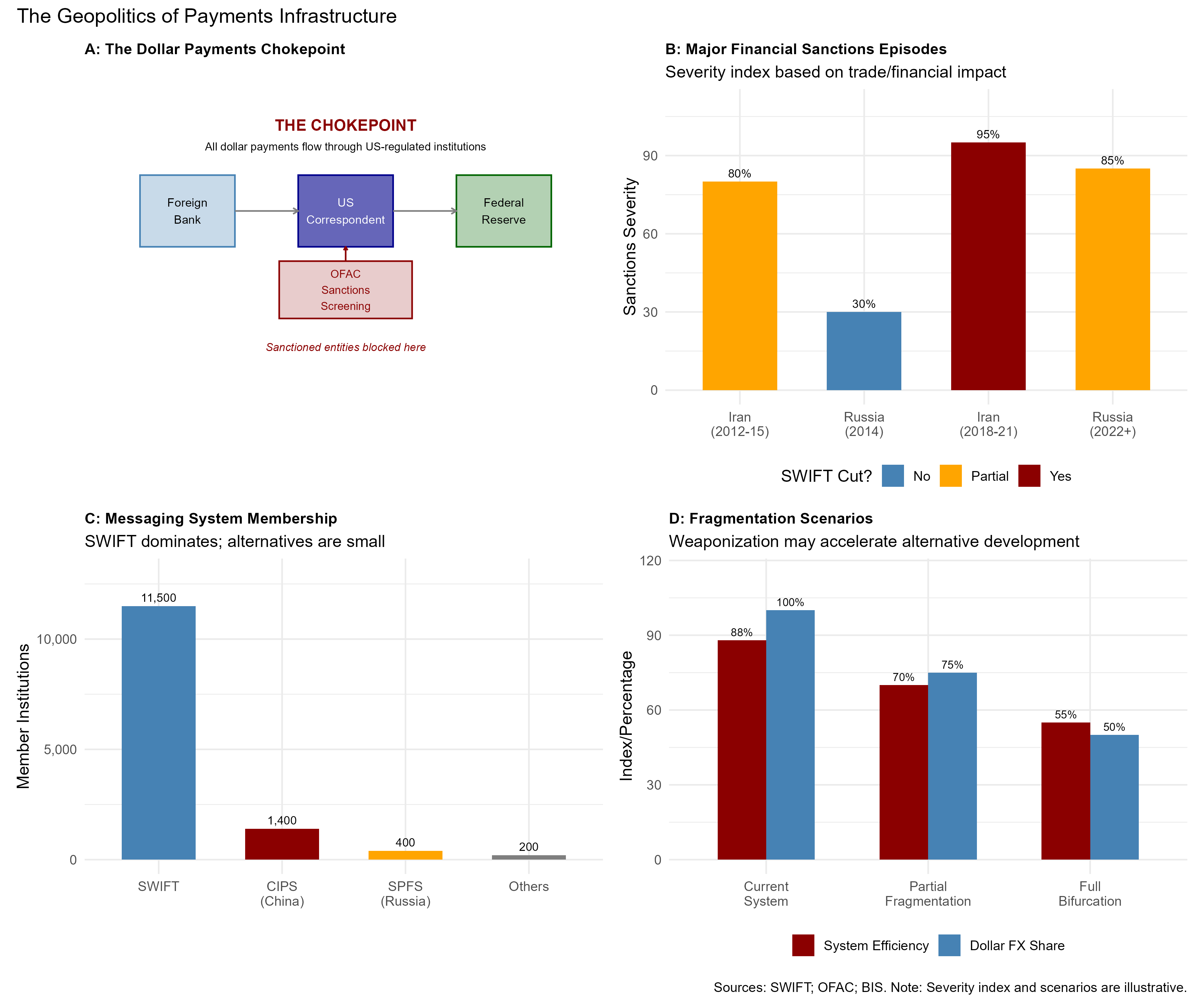
<figure><img src="https://3361520045-files.gitbook.io/~/files/v0/b/gitbook-x-prod.appspot.com/o/spaces%2FG4yYDrutm5bw16KnLiYZ%2Fuploads%2Fgit-blob-439568f3de31be707208035284fc3b9f73c88db2%2Ffig05_4_payment_geopolitics.png?alt=media" alt="Map showing alternative payment systems to SWIFT including China&#x27;s CIPS, Russia&#x27;s SPFS, and EU&#x27;s INSTEX, with connections and regional adoption"><figcaption><p><strong>Figure 5.5:</strong> Payment Geopolitics and Alternative Systems. Countries are developing alternatives to dollar-centric infrastructure to reduce vulnerability to sanctions and exclusion. <em>Illustrative.</em></p></figcaption></figure>

Payment systems have become tools of statecraft. Access to dollar clearing is both an economic necessity and a geopolitical vulnerability.

### The Dollar Payments Chokepoint

Nearly all dollar payments clear through US-regulated institutions. A non-US bank sending dollars must either:

1. Hold an account at the Fed (rarely permitted)
2. Use a US correspondent bank (standard approach)
3. Use a non-US bank with Fed access (rare)

This concentration creates leverage. US sanctions can:

* Prohibit US banks from maintaining correspondent relationships with targeted entities
* Require US banks to screen all dollar payments for sanctions compliance
* Hold US banks liable for processing payments that violate sanctions

A bank losing correspondent access cannot clear dollars—potentially catastrophic for trade-dependent countries.

### Sanctions Architecture

Modern financial sanctions operate through multiple channels:

| Channel                    | Mechanism                                               | Impact                       |
| -------------------------- | ------------------------------------------------------- | ---------------------------- |
| OFAC SDN List              | Prohibits all transactions with listed persons/entities | Complete financial isolation |
| Correspondent restrictions | Prohibits US banks from maintaining accounts            | Loss of dollar clearing      |
| SWIFT exclusion            | Removes from messaging network                          | Increased transaction costs  |
| Secondary sanctions        | Threatens non-US banks processing payments              | Global isolation             |

Iran, under maximum pressure sanctions (2018-2021), lost:

* SWIFT access for major banks
* Dollar clearing through US correspondents
* Euro clearing (European banks feared secondary sanctions)
* Access to the global financial system for most transactions

Russia (2022-present) faces:

* SWIFT exclusion for major banks
* Correspondent banking cutoffs
* Central bank asset freezes
* Ongoing sanctions escalation

### Alternative Systems and Sanctions Evasion

Countries under sanctions have sought alternatives:

**Barter and commodity trade**: Iran exchanged oil for goods with sanctioned trading partners, avoiding financial transactions.

**Local currency settlement**: Russia and China expanded RMB/ruble bilateral trade settlement.

**Cryptocurrency**: Limited use for sanctions evasion; blockchain transparency often makes it unsuitable.

**Alternative messaging**: SPFS (Russia), CIPS (China) provide non-SWIFT channels.

**Dedicated mechanisms**: INSTEX (EU-Iran) attempted to facilitate humanitarian trade without dollar flows; largely failed.

None approaches the efficiency of dollar-based correspondent banking. The infrastructure gap remains vast.

### Fragmentation Risks

Weaponizing payments creates pressure for fragmentation:

**Short-term**: Sanctioned countries develop workarounds; transactions become less transparent **Medium-term**: Countries accelerate development of alternative systems (CIPS, SPFS) **Long-term**: Potential bifurcation into dollar-bloc and non-dollar-bloc payment infrastructures

Fragmentation would be costly: reduced efficiency from multiple parallel systems, higher compliance costs, lost network effects, and less transparency for tracking illicit flows. The dollar system's dominance has been reinforced by the difficulty of building alternatives. But persistent weaponization may eventually overcome those barriers, reducing both US leverage and global financial efficiency.

### Balancing Security and Access

Policymakers face tradeoffs:

**Aggressive sanctions enforcement**:

* Maximizes pressure on targets
* Deters bad actors
* Accelerates development of alternatives
* Increases financial exclusion

**Light-touch approach**:

* Preserves dollar system centrality
* Maintains financial access for legitimate users
* Reduces leverage against bad actors
* May enable illicit finance

The current trajectory emphasizes enforcement, accepting fragmentation as the cost of maintaining pressure. Whether this proves wise depends on how successfully alternatives develop and how valuable financial leverage remains relative to other policy tools.

## 5.8 The Future of Payments Infrastructure

Payment systems are evolving rapidly, driven by technology, geopolitics, and user expectations.

### Instant Payments Going Global

Real-time retail payments are becoming the norm:

| Country | System          | Launch | Daily Transactions |
| ------- | --------------- | ------ | ------------------ |
| UK      | Faster Payments | 2008   | \~10 million       |
| India   | UPI             | 2016   | \~300 million      |
| Brazil  | Pix             | 2020   | \~100 million      |
| US      | FedNow          | 2023   | Ramping up         |

Cross-border instant payments are the next step. The BIS Innovation Hub is piloting connections between domestic instant payment systems, potentially enabling near-real-time international transfers at low cost.

### Central Bank Digital Currencies

**CBDCs**—digital money issued directly by central banks—could reshape payments architecture:

**Wholesale CBDCs** would provide a new settlement asset for financial institutions, potentially enabling:

* 24/7 RTGS settlement (no operating hour limitations)
* Programmable money (automated conditional payments)
* Direct central bank access for a broader range of institutions

**Retail CBDCs** would give the public direct access to central bank money digitally:

* Could reduce reliance on commercial banks
* Might enable cheaper cross-border payments (if CBDCs are interoperable)
* Raises disintermediation concerns

China's **e-CNY** is most advanced among major economies, with pilots in multiple cities. The ECB is developing a **digital euro**. The Fed is studying but proceeding cautiously.

CBDC interoperability matters most for international finance. If different countries' CBDCs can interconnect, cross-border payments could bypass correspondent banking entirely. Projects like **mBridge** (BIS Innovation Hub with China, UAE, Thailand, Hong Kong) are testing multi-CBDC platforms for international settlement.

### Stablecoins and Private Money

**Stablecoins**—privately issued tokens pegged to fiat currencies—have grown to $150+ billion in circulation. They offer:

* 24/7 availability
* Near-instant settlement
* Programmability
* Potential for lower costs

But stablecoins also raise concerns:

* Run risk if reserves prove inadequate
* Regulatory arbitrage (operating outside banking rules)
* Potential for illicit use
* Systemic risk if scaled massively

Regulators worldwide are developing stablecoin frameworks. Whether stablecoins will be integrated into regulated finance or remain a parallel system is unresolved.

### Correspondent Banking's Evolution

Traditional correspondent banking faces pressure from multiple directions:

* Competition from new payment rails
* De-risking reducing access
* Sanctions complicating compliance
* Technology enabling alternatives

Correspondent banking won't disappear—it provides flexibility and reach that specialized systems can't match. But its dominance may erode as alternatives mature.

## Key Concepts

**Payment vs. settlement**: A payment instruction is a message; settlement is the actual transfer of money. The gap between them creates risk.

**Gross vs. net settlement**: Gross settles each payment individually (Fedwire); net settles only the difference across many payments (CHIPS). Netting saves liquidity but creates interdependence.

**Finality**: A payment is final when it cannot be reversed. Central bank money provides finality; commercial bank money doesn't (the bank can fail).

**Herstatt risk**: Settlement risk from time zone differences in FX, named after the 1974 failure. CLS addresses this through payment-versus-payment.

**Correspondent banking**: Banks holding accounts with each other to facilitate cross-border payments. The nostro (our account) / vostro (your account) structure.

**SWIFT vs. payment systems**: SWIFT is messaging (instructions); Fedwire/CHIPS/TARGET2 are payment systems (actual money movement).

**De-risking**: Banks exiting correspondent relationships due to compliance costs and risk concerns.

**Payment system weaponization**: Using access to payment infrastructure as a tool of economic statecraft.

## Summary

Payment infrastructure is the plumbing of finance—invisible when working, catastrophic when failing. The hierarchy of money extends to payments: settlement in central bank money is final; settlement in commercial bank money carries counterparty risk. Dollar-based infrastructure sits at the apex, with access to dollar clearing a prerequisite for participation in global commerce.

Key features of the current system include:

1. **Domestic foundation**: Fedwire provides final settlement in central bank money; CHIPS provides efficient netting for cross-border flows; ACH handles retail payments.
2. **SWIFT as messaging**: SWIFT coordinates instructions but doesn't settle payments. The distinction matters for understanding sanctions.
3. **Correspondent banking**: Cross-border payments flow through nostro/vostro relationships, with the dollar serving as the hub currency.
4. **CLS and FX settlement**: The Herstatt failure demonstrated FX settlement risk; CLS provides payment-versus-payment to eliminate principal risk.
5. **Regional systems**: TARGET2 (Eurozone), CIPS (China), and others serve particular currencies and geographies.
6. **Geopolitical dimension**: Payment systems have become tools of statecraft, with access to dollar clearing serving as a chokepoint for sanctions enforcement.
7. **Future evolution**: Instant payments, CBDCs, and stablecoins may transform the infrastructure, potentially reducing correspondent banking's dominance.

Every transaction—whether trade finance, portfolio investment, or FX trading—ultimately requires settlement. The architecture of settlement systems shapes costs, timing, risks, and the structure of international financial flows.

## Further Reading

For full citations, see the Bibliography. Essential works for this chapter include:

**Essential**: CPMI (2016) on correspondent banking structure. Rice, von Peter, and Boar (2020) document the retreat of correspondent banks.

**Research**: BIS Triennial Survey (2022) for FX market structure. CPSS (1996) on FX settlement risk (the Allsopp Report). Domanski, Gambacorta, and Picillo (2015) on central clearing. FSB (2020) roadmap for cross-border payments. Norman (2010) on correspondent banking mechanics.

***

## Discussion Questions

1. The chapter distinguishes between SWIFT (a messaging system) and actual payment systems like Fedwire and CHIPS. Why does this distinction matter for understanding financial sanctions? When Russia was partially excluded from SWIFT in 2022, why was the impact significant even though SWIFT does not actually move money? How does the money view's focus on the hierarchy of settlement help explain the chokepoint power of dollar-based infrastructure?
2. CLS eliminated Herstatt risk for 18 currencies through payment-versus-payment settlement, yet roughly 60% of global FX transactions still settle outside CLS with residual principal risk. From a money view perspective, why does this gap persist despite the obvious systemic benefits of PvP? Consider costs, membership requirements, currency coverage, and the dealer's survival constraint in your analysis.
3. The chapter describes how TARGET2 balances ballooned during the Eurozone crisis as capital flowed from peripheral to core countries. From a money view perspective, are TARGET2 balances simply accounting entries within a unified currency area, or do they represent real credit risk? How does the answer depend on whether the euro area remains intact? Compare TARGET2 balances to flows between Federal Reserve districts in the United States.
4. Central bank digital currencies (CBDCs) could potentially allow direct cross-border settlement, bypassing correspondent banking entirely. Using the money view framework, analyze how multi-CBDC platforms (like mBridge) could change the hierarchy of money in international payments. Would such a system reduce the dollar's centrality, or would the dollar's structural advantages (deep markets, rule of law, Fed backstop) persist regardless of the payment technology?