# 7. Professional and Business Services

Walk into any office tower in Manhattan, Chicago, or San Francisco and you will find floors of lawyers, consultants, accountants, and software engineers. Most Americans never hire an M\&A attorney or a management consultant, yet professional services generates $2.3 trillion annually and employs 22 million workers. These firms sell expertise---legal judgment, strategic advice, audited financials---and their concentration in a handful of elite metros shapes the economic geography of American cities.

Professional and business services (NAICS 54-56) spans industries united by a single feature: they sell expertise, not physical goods. A law firm sells legal judgment. McKinsey sells strategic advice. Deloitte sells audit opinions and tax planning. Advertising agencies sell creative campaigns and media placement. MBAs, JDs, and CPAs staff these firms, clustered in towers along Park Avenue and Lake Shore Drive, where proximity to clients and competitors drives billion-dollar deals. Since 1980, this sector has added over 12 million jobs while manufacturing shed 6 million.

## Overview

### Size and Scope

* **GDP contribution (2023)**: $2.3 trillion (approximately 9% of GDP)
* **Employment**: 22.4 million workers (Professional, Scientific, Technical Services: 10.2M; Administrative Services: 9.5M; Management of Companies: 2.7M)
* **Establishments**: Over 1.1 million firms
* **Growth**: One of the fastest-growing sectors over the past three decades

Professional services has been a major engine of employment growth since the 1980s. While manufacturing employment fell from 19 million to 13 million between 1980 and 2023, professional and business services employment more than doubled. This shift reflects the broader transformation from a goods-producing to a knowledge-based economy.

### Key Subsectors

| Subsector                 | Revenue (2023 est.) | Employment  | Key Players                                   |
| ------------------------- | ------------------- | ----------- | --------------------------------------------- |
| Legal services            | $370 billion        | 1.1 million | Kirkland & Ellis, Latham & Watkins, DLA Piper |
| Accounting and auditing   | $190 billion        | 1.4 million | Deloitte, PwC, EY, KPMG                       |
| Management consulting     | $330 billion        | 1.0 million | McKinsey, BCG, Bain, Accenture                |
| Architectural/engineering | $380 billion        | 1.5 million | AECOM, Jacobs, WSP                            |
| Computer systems design   | $550 billion        | 2.2 million | Accenture, IBM, Infosys, Cognizant            |
| Advertising and marketing | $280 billion        | 500,000     | WPP, Omnicom, Publicis, IPG                   |
| Scientific R\&D services  | $190 billion        | 750,000     | IQVIA, Charles River, PPD                     |

*Sources: Census Service Annual Survey, BLS QCEW, IBISWorld estimates*

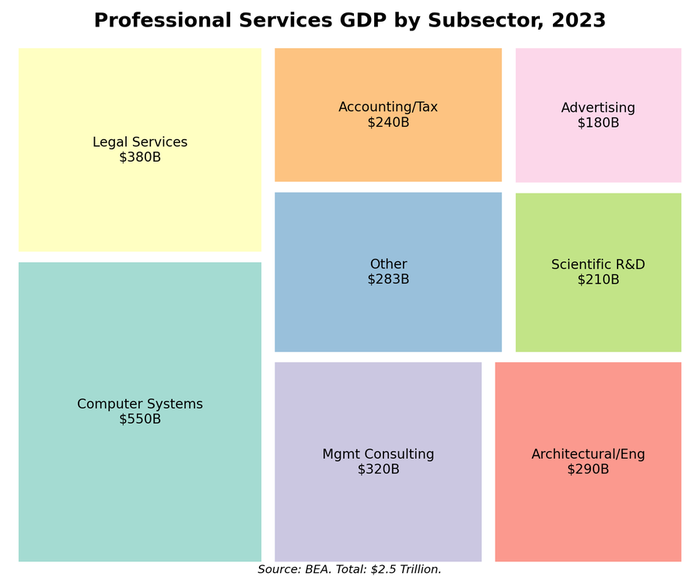
<figure><img src="https://1944841270-files.gitbook.io/~/files/v0/b/gitbook-x-prod.appspot.com/o/spaces%2FlwG86Ea8su498omfBXtX%2Fuploads%2Fgit-blob-c4bcbf9b6724b211c12e2ca6ffa06e62ac846f8b%2Fch07_prof_services_gdp.png?alt=media" alt="Professional services GDP: computer systems design leads, followed by legal and consulting"><figcaption><p>Figure 7.1: Professional services GDP by subsector. Computer systems design ($550B) has overtaken legal services and consulting to become the largest subsector, reflecting the economy's growing dependence on IT outsourcing and digital transformation. Source: BEA (2023)</p></figcaption></figure>

## How the Industry Works

Professional services firms share a distinctive business model that differs fundamentally from manufacturing or retail. They sell hours of expert time, face severe information asymmetries with clients, and depend critically on reputation and relationships.

### The Leverage Model

Most professional services firms operate on a **leverage model**: a small number of senior partners supervise a larger number of junior professionals who do the bulk of the work. The economics are straightforward:

* Partners bill at $1,000-2,000/hour (or more for elite specialists)
* Associates bill at $300-600/hour
* Partners capture the spread between what they bill for associates' time and what associates are paid

The **leverage ratio** (associates per partner) determines profitability. A law firm with 4 associates per partner earns more per partner than one with 2 associates per partner, all else equal. But higher leverage requires more work to keep associates busy—creating pressure to grow revenue.

This model creates a distinctive career structure: the **tournament**. Junior professionals compete for a limited number of partner slots. Those who make partner earn substantial equity stakes; those who don't typically leave ("up or out"). Marc Galanter and Thomas Palay's *Tournament of Lawyers* (1991) formalized this model for law firms, but it applies broadly across consulting, accounting, and investment banking.

{% hint style="warning" %}
**The Tournament's Hidden Costs**

The "up or out" model generates intense effort but also burnout, attrition, and perverse incentives. Associates work 80-hour weeks for years pursuing partnership odds of 10-20%. Those who fail leave with transferable skills but often with strained relationships and health consequences. The model persists because it extracts maximum effort from the young while firms are built on their labor.
{% endhint %}

### Revenue Streams

**Hourly billing** remains dominant in legal services and much of accounting. Clients pay for time spent, creating incentives for efficiency (clients want less time) and inefficiency (firms want more billable hours) that are never fully resolved.

**Project-based fees** are common in consulting and advertising. McKinsey might charge $5-10 million for a three-month strategy project, regardless of hours worked. This aligns incentives with outcomes but requires accurate scoping.

**Contingency fees** (plaintiff's litigation) and **success fees** (M\&A advisory) tie compensation to results. A plaintiff's attorney might take 33% of any settlement; an investment bank might earn 1% of deal value (see Chapter 18 for how investment banks and the broader financial system operate). These arrangements shift risk to the service provider.

**Retainer relationships** provide steady revenue: a corporation pays a law firm $500,000/year for on-call legal advice. Retainers smooth revenue but may create conflicts (the retained firm may be reluctant to recommend costly litigation).

**Audit fees** are unique: public companies are legally required to hire independent auditors, creating a quasi-regulated market. The Big 4 accounting firms audit virtually all large public companies, with fees set through negotiation but constrained by competition for the engagement.

### The Role of Reputation

Professional services markets are plagued by **information asymmetry**: clients cannot easily evaluate service quality. How does a CEO know if the law firm's M\&A advice is sound? How does an audit committee know if the audit was thorough?

**Reputation** partially solves this problem. Elite firms—Cravath in law, McKinsey in consulting, Goldman Sachs in banking—command premium fees because their reputations assure clients of quality. This creates powerful incumbency advantages and explains why the same firms have dominated their industries for decades.

Reputation also explains the **credentialing function** of professional services. When a company hires McKinsey, it's partly buying analysis but also buying legitimacy: "McKinsey recommended this strategy" provides cover for executives. Similarly, a Big 4 audit opinion signals to investors that financial statements are reliable (or at least, that a reputable firm reviewed them).

## Industry Structure

### Legal Services

The US legal services market ($370 billion) is the world's largest, reflecting both the litigiousness of American society and the complexity of American business law.

**Market structure**: Highly fragmented overall (130,000+ law firms), but concentrated at the top. The AmLaw 100 (largest 100 firms by revenue) generate about 40% of total legal revenue. The AmLaw 10 alone account for nearly $30 billion.

**Largest firms by revenue (2023)**:

| Rank | Firm             | Revenue | Lawyers | PPP\* |
| ---- | ---------------- | ------- | ------- | ----- |
| 1    | Kirkland & Ellis | $7.2B   | 3,600   | $7.5M |
| 2    | Latham & Watkins | $5.8B   | 3,200   | $5.6M |
| 3    | DLA Piper        | $3.7B   | 4,500   | $2.1M |
| 4    | Baker McKenzie   | $3.4B   | 4,700   | $1.6M |
| 5    | Skadden          | $3.3B   | 1,700   | $5.2M |

*PPP = Profits Per Partner. Source: American Lawyer*

{% hint style="info" %}
**Key Metric: Profits Per Partner (PPP)**

PPP measures a law firm's profitability by dividing total partner profits by number of equity partners. A firm with $500M in profits and 100 equity partners has PPP of $5M. This metric drives firm strategy: partners resist promoting new partners (dilutes PPP) and push for higher leverage (increases PPP). The AmLaw rankings by PPP create intense competitive pressure.
{% endhint %}

**Specialization**: Large firms increasingly specialize. Kirkland & Ellis dominates private equity work; Wachtell Lipton is the premier M\&A defense firm; Quinn Emanuel leads commercial litigation. Specialization allows expertise development but creates "rainmaker" dependency—partners who control client relationships hold enormous power.

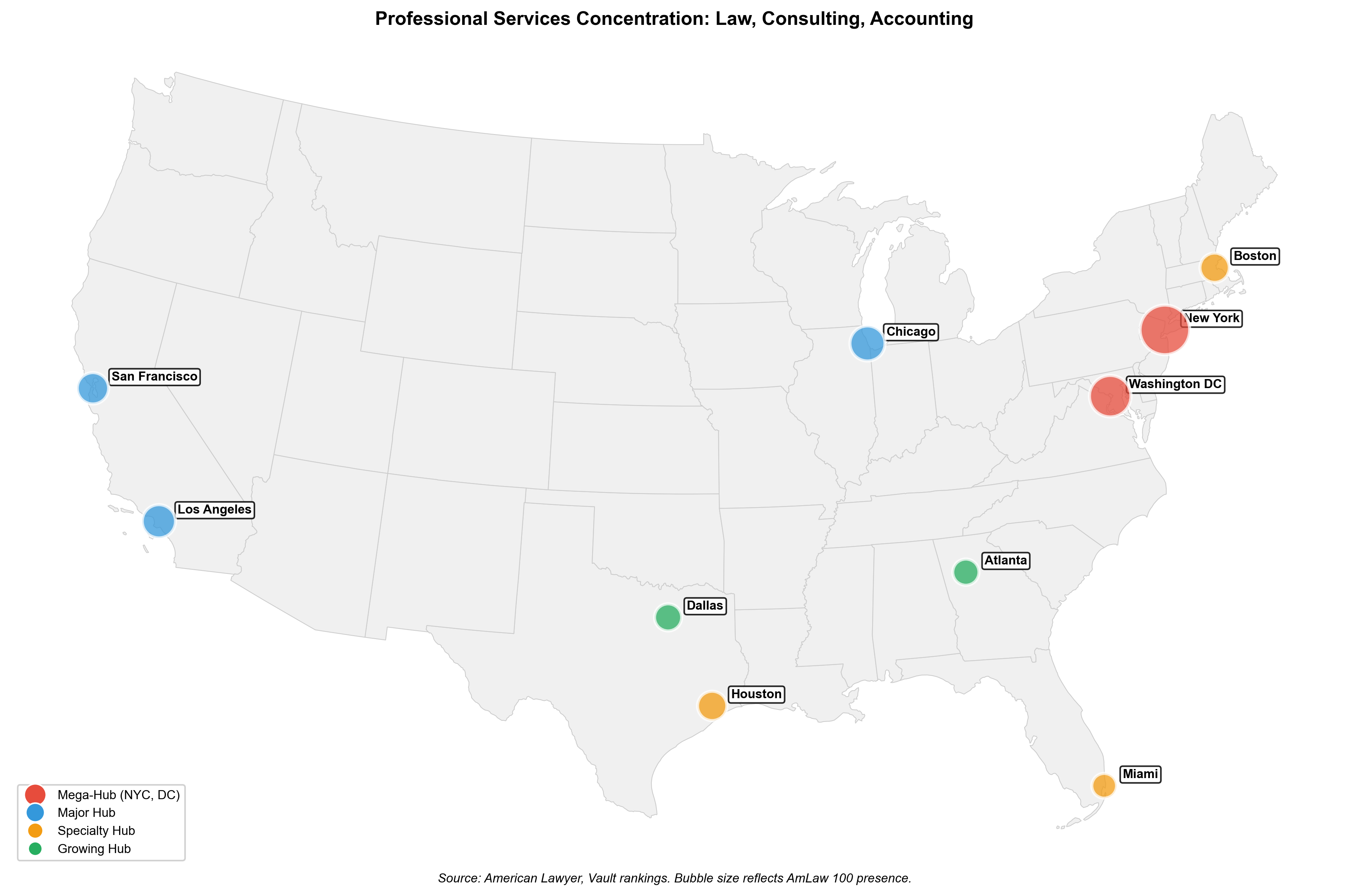
**Geographic concentration**: Legal services concentrate in major business centers. New York (especially Midtown Manhattan) hosts the largest cluster, followed by Washington DC (regulatory/government work), Chicago, Los Angeles, and San Francisco/Silicon Valley.

<figure><img src="https://1944841270-files.gitbook.io/~/files/v0/b/gitbook-x-prod.appspot.com/o/spaces%2FlwG86Ea8su498omfBXtX%2Fuploads%2Fgit-blob-0b554ead4e8252d9d9b5ca9213557bf57e69647e%2Fch07_professional_hubs.png?alt=media" alt="Map showing professional services concentrated in New York and Washington DC mega-hubs"><figcaption><p>Figure 7.2: Professional services concentration by metro. NYC and DC dominate as "mega-hubs," hosting the majority of AmLaw 100 firms and Big Four offices. Source: American Lawyer, Vault rankings</p></figcaption></figure>

**Key trends**:

* Rising associate salaries (first-year associates at top firms now earn $215,000+)
* Growing in-house legal departments (corporations bringing work inside)
* Alternative Legal Service Providers (ALSPs) handling routine work
* Slow adoption of technology despite "LegalTech" hype

### Accounting and Auditing

The accounting industry is dominated by the **Big 4**: Deloitte, PwC, EY, and KPMG. These firms audit virtually all large public companies and provide tax and consulting services to corporations worldwide.

**Big 4 statistics (2023)**:

| Firm     | Global Revenue | US Revenue | US Employees |
| -------- | -------------- | ---------- | ------------ |
| Deloitte | $65B           | $28B       | 175,000      |
| PwC      | $53B           | $21B       | 75,000       |
| EY       | $50B           | $20B       | 78,000       |
| KPMG     | $36B           | $14B       | 40,000       |

{% hint style="warning" %}
**Too Big to Fail? The Big 4 Problem**

The Big 4 audit 99% of S\&P 500 companies. If one firm collapsed (as Arthur Andersen did after Enron), the remaining three could not absorb its clients---creating systemic risk for capital markets. Regulators have considered structural reforms (mandatory firm rotation, audit-only firms) but none have been implemented. The Big 4 remain too big to fail and too essential to regulate aggressively.
{% endhint %}

*Sources: Firm disclosures*

**Market concentration**: The Big 4's dominance in audit is extraordinary—they audit approximately 99% of S\&P 500 companies. This concentration raises concerns about systemic risk (what if a Big 4 firm failed?) and competitive dynamics (limited choice for large companies needing auditors).

**Service lines**: The Big 4 are not just auditors. Revenue breaks down roughly as:

* Audit and assurance: 35-40%
* Tax services: 25-30%
* Consulting/advisory: 30-40%

The mix has shifted toward consulting, which offers higher margins and faster growth than commoditized audit work.

**Regulatory environment**: Auditing is quasi-regulated. The SEC requires public companies to have audited financial statements; the PCAOB (Public Company Accounting Oversight Board) inspects audit quality; Sarbanes-Oxley (2002) restricted auditors from providing certain consulting services to audit clients.

**Key tensions**:

* Independence vs. client service (auditors are paid by the companies they audit)
* Quality vs. cost (audit fees are under constant pressure)
* Consulting growth vs. audit independence (conflicts of interest)

### Management Consulting

The management consulting industry ($330 billion in the US) advises corporations on strategy, operations, technology, and organization.

**Market structure**: More fragmented than accounting, but with clear tiers:

**Strategy consulting** (the elite tier):

* McKinsey & Company (roughly $16B global revenue, roughly 6,000 US consultants)
* Boston Consulting Group (roughly $12B global, roughly 5,000 US)
* Bain & Company (roughly $6B global, roughly 3,500 US)

**Big 4 consulting arms** (volume and technology):

* Deloitte Consulting, PwC Advisory, EY-Parthenon, KPMG Advisory

**Technology/implementation consultants**:

* Accenture (roughly $65B global, massive scale)
* IBM Consulting, Capgemini, Cognizant

**Boutiques and specialists**: Thousands of smaller firms focusing on specific industries or functions.

**Business model**: Strategy consultants sell "thought leadership"—frameworks, analyses, recommendations delivered by teams of bright MBAs working 80-hour weeks. The output is typically a PowerPoint deck presented to executives, though implementation support has become more common.

**Why do companies hire consultants?** Bloom and Van Reenen's research (JEP, 2010) suggests consultants spread best practices across firms, improving management quality. But critics argue consulting often provides "legitimacy" for decisions executives have already made, or serves as an expensive form of benchmarking that could be done more cheaply.

### Computer Systems Design and IT Services

The largest professional services subsector by revenue ($550 billion) encompasses the service side of the technology ecosystem discussed in Chapter 11:

* Custom software development
* Systems integration
* IT outsourcing
* Cloud services implementation

**Market structure**: Highly diverse, from global giants to small development shops.

**Major players**:

* Accenture: $65B global revenue, 740,000 employees (the largest)
* IBM Consulting: roughly $20B (spun from IBM's services arm)
* Infosys, TCS, Wipro: Indian-headquartered firms with large US operations
* Cognizant: $19B, US-headquartered but India-delivery model
* Thousands of smaller system integrators and consultancies

**Offshore delivery**: Much IT services work is performed offshore (India, Philippines, Eastern Europe) with US-based client management. This "global delivery model" dramatically lowered costs and enabled the industry's growth, but also limited US employment growth in this subsector.

**Cloud transformation**: The shift to cloud computing (AWS, Azure, Google Cloud) has restructured the industry. Implementation of cloud solutions is now a major revenue stream.

### Advertising and Marketing Services

The advertising industry ($280 billion) creates and places marketing communications across media channels.

**Market structure**: Consolidated at the top into four major holding companies:

| Holding Company | Headquarters | Revenue | Major Agencies                |
| --------------- | ------------ | ------- | ----------------------------- |
| WPP             | London       | $18B    | Ogilvy, Grey, GroupM          |
| Omnicom         | New York     | $14B    | BBDO, DDB, OMD                |
| Publicis        | Paris        | $14B    | Saatchi, Leo Burnett, Starcom |
| IPG             | New York     | $11B    | McCann, FCB, UM               |

These holding companies own dozens of individual agencies, allowing them to serve competing clients through different subsidiaries.

**The agency model**: Traditional agencies combine:

* Creative services (developing ad concepts and content)
* Media buying (purchasing ad space/time)
* Account management (client relationships)

**Digital disruption**: The rise of Google and Meta (Facebook) transformed the industry. These platforms now capture over 50% of US digital ad spending, disintermediating traditional media buying. Agencies have responded by building digital capabilities, but their role in a programmatic, algorithm-driven ad market is uncertain.

**The attention economy**: Tim Wu's *The Attention Merchants* (2016) traces the business model of capturing and selling attention from 19th-century newspapers through modern social media. Advertising agencies are intermediaries in this attention market—and increasingly squeezed between powerful platforms and cost-conscious clients.

### Architecture and Engineering Services

A\&E services ($380 billion) design buildings, infrastructure, and industrial facilities.

**Market structure**: Highly fragmented. No firm dominates; the largest (AECOM, Jacobs) have market shares under 5%.

**Largest firms (by US revenue)**:

| Firm    | US Revenue | Specialty                  |
| ------- | ---------- | -------------------------- |
| AECOM   | $8B        | Infrastructure, government |
| Jacobs  | $7B        | Government, industrial     |
| WSP     | $4B        | Transportation, buildings  |
| Stantec | $3B        | Environmental, buildings   |
| HDR     | $2.5B      | Healthcare, transportation |

**Business model**: Fee-based professional services, typically as a percentage of construction cost (5-15% depending on project complexity). Work is project-based and highly cyclical—architecture billings are a leading indicator of construction activity.

**The AIA Architecture Billings Index**: The American Institute of Architects publishes a monthly index tracking billings at architecture firms. Because design precedes construction by 9-12 months, the ABI serves as an early warning system for construction downturns.

## Geographic Distribution

Professional services are among the most geographically concentrated industries in the American economy.

### Metropolitan Concentration

The top 10 metropolitan areas account for over 50% of professional services employment:

| Metro Area        | Prof. Services Employment | Specialization                     |
| ----------------- | ------------------------- | ---------------------------------- |
| New York-Newark   | 1.8 million               | Law, finance services, advertising |
| Los Angeles       | 900,000                   | Entertainment law, tech            |
| Chicago           | 700,000                   | Consulting, accounting             |
| Washington DC     | 680,000                   | Government consulting, law         |
| Dallas            | 550,000                   | Energy consulting, accounting      |
| San Francisco Bay | 520,000                   | Tech consulting, VC law            |
| Boston            | 450,000                   | Consulting, life sciences          |
| Houston           | 400,000                   | Energy engineering                 |
| Atlanta           | 380,000                   | Regional services hub              |
| Philadelphia      | 340,000                   | Pharma consulting, law             |

*Source: BLS Quarterly Census of Employment and Wages*

### Why Services Concentrate

Agglomeration economies explain the clustering:

**Knowledge spillovers**: Professionals learn from proximity to other professionals. A lawyer in New York encounters more deal structures, a consultant in Boston more strategic frameworks, than counterparts in smaller markets.

**Thick labor markets**: Concentrated markets make job matching easier. Firms can find specialized talent; workers can find firms matching their expertise.

**Client proximity**: Professional services require intensive client interaction. Lawyers need to be near corporate headquarters; consultants near executive suites. This creates a virtuous cycle: firms locate near clients; sophisticated clients demand sophisticated firms; more firms arrive.

**Signaling and status**: A Manhattan address signals prestige. Clients perceive firms in elite locations as higher quality, allowing them to charge premium fees.

## The Workforce

### Education and Credentials

Professional services employs the most educated workforce in the economy:

| Occupation            | Typical Education             | Credential                    |
| --------------------- | ----------------------------- | ----------------------------- |
| Lawyer                | J.D. (3 years post-college)   | Bar admission                 |
| CPA                   | Bachelor's + 150 credit hours | CPA license                   |
| Management consultant | MBA common, not required      | None required                 |
| Architect             | B.Arch or M.Arch              | State license                 |
| Engineer (PE)         | B.S. Engineering              | Professional Engineer license |

Credentialing creates barriers to entry that limit competition and support high wages. The bar exam, CPA exam, and architectural licensing exam all restrict supply of practitioners.

### Compensation

Professional services wages span an enormous range:

**Entry level**:

* First-year BigLaw associate: $215,000 + bonus
* Big 4 audit associate: $65,000-80,000
* Entry management consultant (MBA): $175,000 + bonus
* Junior architect: $55,000-70,000

**Senior/Partner level**:

* BigLaw equity partner: $2-10+ million
* Big 4 partner: $500,000-2+ million
* McKinsey senior partner: $2-5+ million
* Principal architect: $150,000-300,000

**Wage inequality**: Professional services exhibits extreme within-industry inequality. Partners at elite firms earn 20-50x what junior staff earn. This tournament structure provides strong incentives but creates brutal competition.

### Working Conditions

Professional services is notorious for long hours:

* BigLaw associates: 2,000-2,400 billable hours/year (implying 2,500-3,000 hours worked)
* Investment banking analysts: 80-100 hours/week during deals
* Management consultants: 60-80 hours/week, heavy travel
* Big 4 audit staff: 50-70 hours/week during busy season (January-April)

These hours create work-life balance challenges and contribute to high attrition. Most professionals leave their first employer within 5-7 years—either for partner-track positions elsewhere, in-house roles at corporations, or career changes.

## Regulation and Policy

### Professional Licensing

Most professional services are regulated through state licensing:

* **Lawyers**: State bar associations (under state supreme court supervision)
* **CPAs**: State boards of accountancy
* **Architects**: State licensing boards
* **Engineers**: State boards of professional engineers

Licensing requirements typically include education, examination, and experience. Critics argue licensing restricts competition and raises prices; defenders argue it protects consumers from incompetent practitioners. Hadfield (2022) documents how legal profession regulations limit innovation and access to justice.

### Antitrust and Competition

Professional services historically enjoyed antitrust exemptions (the "learned professions" doctrine). This changed with *Goldfarb v. Virginia State Bar* (1975), which held that lawyers are subject to antitrust law.

Current issues include:

* **Non-compete clauses**: Restrict worker mobility; FTC has proposed banning them
* **Professional association rules**: May limit advertising, fee structures, unauthorized practice
* **Big 4 concentration**: Regulators periodically consider whether audit market concentration harms competition

### Sarbanes-Oxley and Audit Reform

The Enron and WorldCom scandals led to the Sarbanes-Oxley Act (2002), which:

* Created the PCAOB to oversee auditors
* Restricted auditor consulting services to audit clients
* Required CEO/CFO certification of financial statements
* Strengthened audit committee independence requirements

SOX increased audit costs substantially but arguably improved audit quality and corporate governance.

## Trade Associations and Lobbying

### Major Associations

| Association                          | Members                | Focus                                |
| ------------------------------------ | ---------------------- | ------------------------------------ |
| American Bar Association             | 400,000 lawyers        | Legal profession standards, lobbying |
| AICPA                                | 430,000 CPAs           | Accounting standards, licensing      |
| Management Consultancies Association | Major consulting firms | Industry promotion                   |
| American Institute of Architects     | 98,000 architects      | Licensing, building codes            |
| 4A's                                 | Advertising agencies   | Industry standards, self-regulation  |

### Political Activity

Professional services firms are major political donors and lobbyists:

* Law firms rank among the largest political contributors (lawyers skew Democratic)
* Accounting firms lobby heavily on tax policy and audit regulation
* Tech companies (including IT services) have become major lobbying forces

The revolving door between professional services and government is well-traveled: lawyers become judges and regulators; consultants advise campaigns and enter administrations; accountants staff the SEC and IRS.

## Recent Trends

### 1. Technology and Automation

**LegalTech** promises to automate routine legal work—document review, contract analysis, due diligence. Tools like Kira Systems and Luminance use machine learning. So far, adoption has been slow; lawyers remain skeptical and clients haven't demanded change.

**AI in consulting**: McKinsey and others have invested heavily in data analytics and AI capabilities. The question is whether AI enhances consultant productivity or eventually replaces it.

### 2. Alternative Service Providers

**Alternative Legal Service Providers (ALSPs)** like Axiom and UnitedLex offer legal work at lower cost than law firms, using technology and lower-cost labor. The Big 4 accounting firms have also entered legal services (where permitted).

**Gig economy**: Platforms like Upwork and Toptal connect clients directly with freelance professionals, bypassing traditional firms for some work.

### 3. Remote Work

COVID-19 proved that much professional services work can be done remotely. This has implications for:

* Geographic concentration (can firms hire anywhere?)
* Office real estate (do firms need expensive urban space?)
* Work-life balance (or work-life blur?)

The industry is still sorting out the new equilibrium.

### 4. ESG and Purpose

Professional services firms face pressure to demonstrate social responsibility—declining certain clients (fossil fuels, tobacco), improving diversity, addressing climate impact. McKinsey faced reputational damage from opioid-related consulting; law firms have been criticized for representing controversial clients.

## Firm Profiles

### McKinsey & Company

> **Quick Facts**
>
> * Headquarters: New York, NY
> * Founded: 1926
> * Revenue: roughly $16 billion (2023, estimated)
> * Employees: 45,000 globally, roughly 6,000 US consultants

McKinsey is the world's most prestigious management consulting firm, known for advising CEOs on strategy and for producing many corporate and government leaders (current and former clients include numerous Fortune 500 CEOs, cabinet secretaries, and central bank governors).

The firm pioneered many practices now standard in consulting: the case interview, the "up or out" promotion system, and the emphasis on structured problem-solving. McKinsey consultants are known for their frameworks, their PowerPoint decks, and their willingness to render confident judgments on industries they've just encountered.

McKinsey's influence is both celebrated and criticized. *The Lords of Strategy* (Kiechel, 2011) credits McKinsey with inventing modern corporate strategy. Critics argue the firm spreads management fads, enables corporate cost-cutting that harms workers, and has advised authoritarian governments. Recent controversies include work for opioid manufacturers and the Saudi government.

The firm is a partnership; there are no public financial disclosures. But it is believed to be highly profitable, with senior partners earning $5+ million annually.

### Deloitte

> **Quick Facts**
>
> * Headquarters: New York, NY (US entity)
> * Founded: 1845 (London), US practice established 1890s
> * Revenue: $65 billion globally, roughly $28 billion US (2023)
> * Employees: 175,000 US, 450,000 globally

Deloitte is the largest professional services firm in the world, offering audit, tax, consulting, and advisory services. In the US, it is the largest of the Big 4 by revenue and headcount.

Unlike consulting boutiques, Deloitte's scale allows it to serve the full range of corporate needs—from annual audits to massive technology implementations to tax planning across dozens of jurisdictions. This breadth is both a strength (one-stop shopping) and a challenge (managing conflicts between audit independence and consulting revenue).

Deloitte has invested heavily in technology and industry specialization. Its consulting arm competes directly with McKinsey and Accenture; its tax practice is the largest in the country. The firm recruits heavily from top universities and business schools, employing a substantial fraction of each year's accounting and MBA graduates.

### AECOM

> **Quick Facts**
>
> * Headquarters: Dallas, TX
> * Founded: 1990 (through mergers)
> * Revenue: roughly $14 billion (2023)
> * Employees: 50,000

AECOM is the largest architecture and engineering firm in the United States, providing design, construction management, and operations services for infrastructure, buildings, and industrial facilities.

The firm exemplifies the consolidation trend in A\&E: it was built through dozens of acquisitions, assembling capabilities across transportation, water, environment, energy, and buildings. Major projects include Los Angeles International Airport modernization, New York's Second Avenue Subway, and numerous military installations.

AECOM's business is heavily tied to government infrastructure spending. It ranks among the largest federal contractors and derives substantial revenue from state and local transportation departments. This makes it sensitive to public sector budget cycles but provides relative stability compared to private-sector-focused competitors.

{% hint style="info" %}
**Cross-Cutting Connections**

*Inequality*: Professional services epitomize winner-take-all compensation dynamics, where the education premium and partnership structures concentrate earnings at the top of the income distribution. *Climate and Environment*: Surging demand for ESG consulting, carbon accounting, and climate-risk advisory has created one of the fastest-growing practice areas across major firms. *Demographics*: A wave of senior partner retirements threatens institutional client relationships, while firms compete intensely for a shrinking pipeline of young talent willing to accept demanding work cultures. *Technology and AI*: AI tools are automating routine legal research, audit procedures, and financial analysis, threatening traditional billable-hour models while creating opportunities in LegalTech and advisory around AI adoption itself.
{% endhint %}

## Data Sources and Further Reading

### Key Data Sources

* **BLS Quarterly Census of Employment and Wages (QCEW)**: Employment and wages by detailed industry and geography
* **Census Service Annual Survey**: Revenue and expenses for service industries
* **BEA GDP by Industry**: Value added for professional services sectors
* **American Lawyer**: Law firm financial data (subscription)
* **Vault.com**: Consulting and professional services firm rankings
* **AIA Architecture Billings Index**: Monthly leading indicator

### Further Reading

**Academic:**

* Gillian K. Hadfield, "Legal Markets," *Journal of Economic Literature* (2022) — Comprehensive survey of legal services economics
* Nicholas Bloom and John Van Reenen, "Why Do Management Practices Differ across Firms and Countries?" *JEP* (2010) — Economic rationale for consulting
* David S. Evans, "The Online Advertising Industry," *JEP* (2009) — Two-sided market analysis

**Books:**

* Walter Kiechel III, *The Lords of Strategy* (2010) — History of McKinsey, BCG, Bain
* Duff McDonald, *The Firm* (2013) — McKinsey deep dive
* Marc Galanter and Thomas Palay, *Tournament of Lawyers* (1991) — Classic on law firm economics
* Tim Wu, *The Attention Merchants* (2016) — History of advertising business model
* Ian D. Gow and Stuart Kells, *The Big Four* (2018) — Accounting industry structure

**Industry:**

* American Lawyer, "Am Law 100" (annual) — Law firm rankings and financials
* Vault Guide to Consulting (annual) — Consulting firm profiles and rankings

## Exercises

### Review Questions

1. The chapter describes the "leverage model" in professional services: partners bill at $1,000--2,000/hour while associates bill at $300--600/hour, and partners capture the spread. Explain why a law firm with a leverage ratio of 4 associates per partner is more profitable per partner than one with 2 associates per partner, assuming similar billing rates. What are the risks of pursuing ever-higher leverage?
2. Kirkland & Ellis generates $7.2 billion in revenue with 3,600 lawyers and Profits Per Partner (PPP) of $7.5 million. DLA Piper generates $3.7 billion with 4,500 lawyers and PPP of $2.1 million. What differences in specialization, leverage ratio, billing rates, or client mix explain this gap? Why does the AmLaw PPP ranking create competitive pressure among firms?
3. The Big 4 accounting firms (Deloitte, PwC, EY, KPMG) audit 99% of S\&P 500 companies. The chapter warns this is a potential systemic risk. What happened when Arthur Andersen collapsed after the Enron scandal? Why couldn't the remaining firms simply absorb a failed Big 4 firm's clients? What structural reforms have regulators considered?
4. The chapter argues that when a company hires McKinsey, it is "partly buying analysis but also buying legitimacy." Explain how this credentialing function relates to the information asymmetry problem in professional services. Why might a CEO pay $5--10 million for a consulting project whose recommendations they could have developed internally?
5. Professional services employment more than doubled from 1980 to 2023 while manufacturing shed 6 million jobs over the same period. What does this shift reveal about the transformation from a goods-producing to a knowledge-based economy? Is a professional services job a direct substitute for a manufacturing job in terms of skills, geography, or wages?
6. Google and Meta now capture over 50% of U.S. digital ad spending, disintermediating traditional media buying by advertising agencies. How has the rise of programmatic, algorithm-driven advertising changed the role of agencies like WPP, Omnicom, and Publicis? What services can agencies still provide that platforms cannot?

### Data Exercises

7. Using the BEA's GDP by Industry data (bea.gov/data/gdp/gdp-industry), compare the value added of "Professional, Scientific, and Technical Services" (NAICS 54) with "Manufacturing" (NAICS 31-33) from 2000 to the most recent year available. In what year did professional services value added surpass manufacturing? What has been the growth rate differential between the two sectors?
8. Go to the BLS Quarterly Census of Employment and Wages (data.bls.gov/cew) and look up employment in NAICS 5411 (Legal Services) for the New York-Newark-Jersey City metro area and for the nation as a whole. What share of national legal services employment is concentrated in New York? Compare this to New York's share of total nonfarm employment. What does the difference tell you about the geographic concentration of legal services?
9. Using FRED (fred.stlouisfed.org), pull the series "CES6000000001" (All Employees: Professional and Business Services) and "MANEMP" (All Employees: Manufacturing). Plot both from 1990 to the present. Identify the crossover point. How did the 2008 recession and the COVID-19 pandemic affect each series differently? What does the relative resilience of professional services employment suggest about its business cycle sensitivity?

### Deeper Investigation

10. Research the potential impact of large language models and generative AI on one professional services subsector: legal services, accounting and audit, management consulting, or advertising. Identify specific tasks within that subsector that are most susceptible to automation (e.g., document review in law, data analysis in consulting, copywriting in advertising). What tasks require human judgment, client relationships, or creativity that current AI cannot replicate? Drawing on the chapter's discussion of the leverage model and tournament structure, assess whether AI will primarily eliminate junior positions, augment senior productivity, or fundamentally restructure how the subsector delivers value.